

【C++初阶】日期类实现、const成员函数、取地址及const取地址操作符重载
🌟hello,各位读者大大们你们好呀🌟
🍭🍭系列专栏:【C++学习与应用】
✒️✒️本篇内容:日期类的代码实现、const成员函数的概念和作用、取地址及const取地址操作符重载
🚢🚢作者简介:计算机海洋的新进船长一枚,请多多指教( •̀֊•́ ) ̖́-
📡📡同期文章:【C++初阶】简析构造函数、析构函数
【C++初阶】简析拷贝构造、赋值运算符重载
目录
一、引言
二、日期类
1. 获取某年某月的天数
2.全缺省的构造函数
3.拷贝构造函数
4.赋值运算符重载
5.析构函数
6.日期+天数
7.日期+=天数
8.日期-天数
9.日期-=天数
10.前置++
11.后置++
12.前置--
13.后置--
14.>运算符重载
15.==运算符重载
16.>=运算符重载
17.<运算符重载
18.<=运算符重载
19.!=运算符重载
20.日期-日期 返回天数
三、const成员函数
四、取地址及const取地址操作符重载
一、引言
之前我们学习了赋值运算符重载的相关知识,今天就让我们一起通过日期类实现,用代码来实践一下赋值运算符重载,深入了解部分代码细节。
学习完日期类的实现后,我们再进入下一块知识:const成员,取地址及const取地址操作符重载,领会C++设立const成员语法的意义。
二、日期类
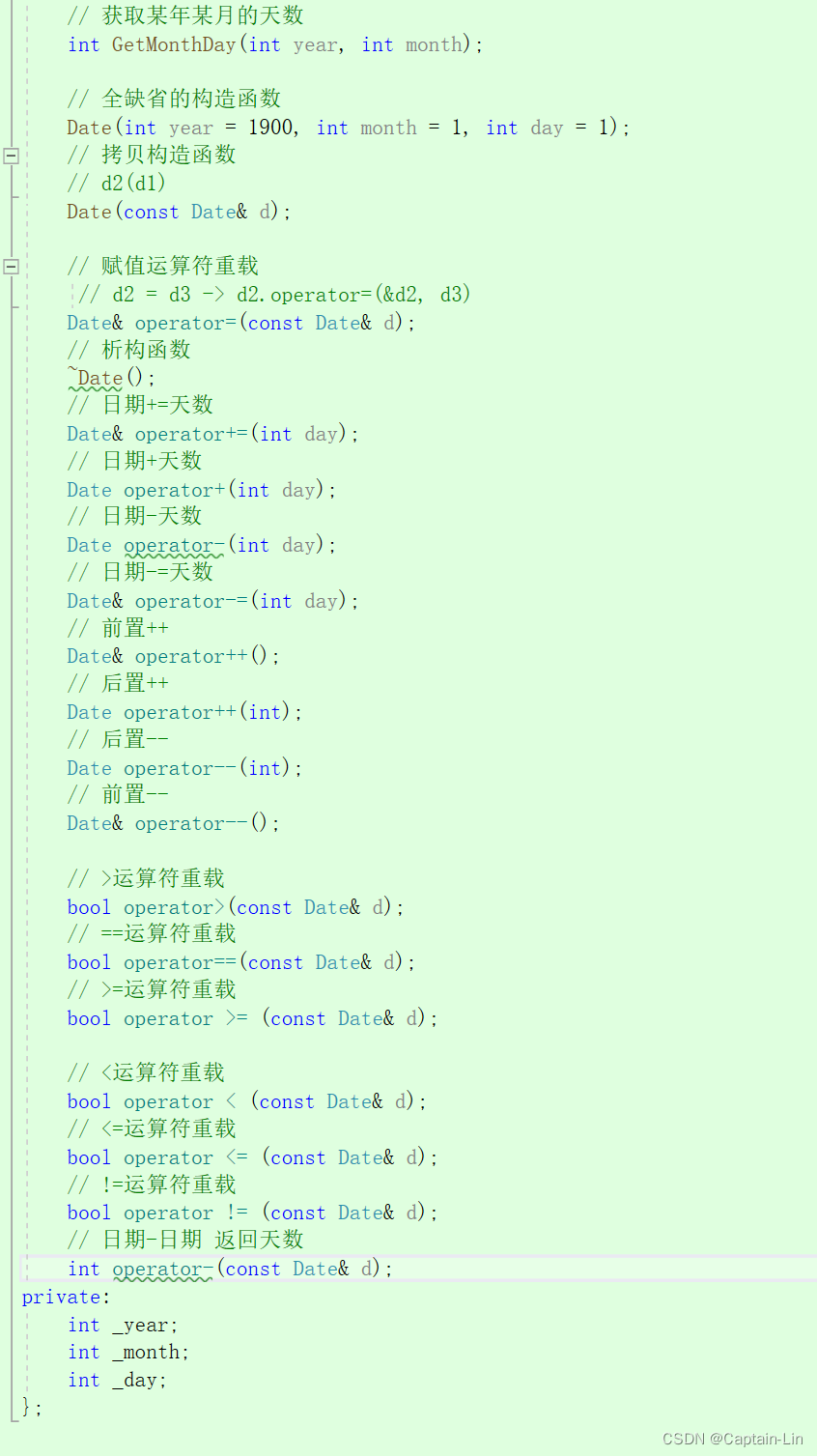
日期类计划主要用代码讲解,以下讲解的函数主要为类的成员函数
1. 获取某年某月的天数
// 获取某年某月的天数int GetMonthDay(int year, int month){static int monthDayArray[13] = { 0, 31, 28, 31, 30, 31, 30, 31, 31, 30, 31, 30, 31 };if (month == 2 && ((year % 4 == 0 && year % 100 != 0) || (year % 400 == 0))){return 29;}else{return monthDayArray[month];}}2.全缺省的构造函数
// 全缺省的构造函数Date(int year = 1900, int month = 1, int day = 1){_year = year;_month = month;_day = day;// 检查日期是否合法if (!(year >= 1&& (month >= 1 && month <= 12)&& (day >= 1 && day <= GetMonthDay(year, month)))){cout << "非法日期" << endl;}}3.拷贝构造函数
// 拷贝构造函数// d2(d1)Date(const Date& d){_year = d._year;_month = d._month;_day = d._day;}4.赋值运算符重载
// 赋值运算符重载// d2 = d3 -> d2.operator=(&d2, d3)Date& operator=(const Date& d){if (this != &d){_year = d._year;_month = d._month;_day = d._day;}return *this;}5.析构函数
由于是日期类,对象都是内置类型,我们可以使用编译器默认生成的析构函数
6.日期+天数
// 日期+天数// Date Date::operator+(int day) const - 声明定义分离写法Date operator+(int day){Date ret(*this);ret += day;return ret;}7.日期+=天数
// 日期+=天数// Date& Date::operator+=(int day) - 声明定义分离写法Date& operator+=(int day){if (day < 0){//return *this -= -day;return *this -= abs(day);//abs求绝对值}_day += day;while (_day > GetMonthDay(_year, _month))//day>某年某月的天数{_day -= GetMonthDay(_year, _month);_month++;if (_month == 13)//超过12月,加1年,月回1{++_year;_month = 1;}}return *this;}8.日期-天数
// 日期-天数// Date Date::operator-(int day) const - 声明定义分离写法Date operator-(int day){Date ret(*this);ret -= day;return ret;}9.日期-=天数
// 日期-=天数// Date& Date::operator-=(int day) - 声明定义分离写法Date& operator-=(int day){if (day < 0){//return *this -= -day;return *this += abs(day);}_day -= day;while (_day <= 0){--_month;if (_month == 0){--_year;_month = 12;}_day += GetMonthDay(_year, _month);}return *this;}10.前置++
// 前置++// Date& Date::operator++() - 声明定义分离写法Date& operator++(){*this += 1;return *this;}11.后置++
// 后置++// Date Date::operator++(int) - 声明定义分离写法Date operator++(int){Date tmp(*this);*this += 1;return tmp;}12.前置--
// 前置--// Date& Date::operator--() - 声明定义分离写法Date& operator--(){*this -= 1;return *this;}13.后置--
// 后置--// Date Date::operator--(int) - 声明定义分离写法Date operator--(int){Date tmp = *this;*this -= 1;return tmp;}14.>运算符重载
// >运算符重载// bool Date::operator>(const Date& d) const - 声明定义分离写法bool operator>(const Date& d){if (_year > d._year){return true;}else if (_year == d._year && _month > d._month){return true;}else if (_year == d._year && _month == d._month && _day > d._day){return true;}return false;}15.==运算符重载
// ==运算符重载bool operator==(const Date& d) - 声明定义分离写法{return _year == d._year&& _month == d._month&& _day == d._day;}16.>=运算符重载
// >=运算符重载// bool Date::operator>=(const Date& d) const - 声明定义分离写法bool operator >= (const Date& d){return *this > d || *this == d;}17.<运算符重载
// <运算符重载// bool Date::operator<(const Date& d) const - 声明定义分离写法bool operator < (const Date& d){return !(*this >= d);}18.<=运算符重载
// <=运算符重载// bool Date::operator<=(const Date& d) const - 声明定义分离写法bool operator <= (const Date& d){return !(*this > d);}19.!=运算符重载
// !=运算符重载// bool Date::operator!=(const Date& d) const - 声明定义分离写法bool operator != (const Date& d){return !(*this == d);}20.日期-日期 返回天数
// 日期-日期 返回天数//int Date::operator-(const Date& d) const - 声明定义分离写法int operator-(const Date& d){Date max = *this;Date min = d;int flag = 1;if (*this < d)//if (d > *this){max = d;min = *this;flag = -1;}int n = 0;while (min != max){++n;++min;}return n * flag;}三、const成员函数
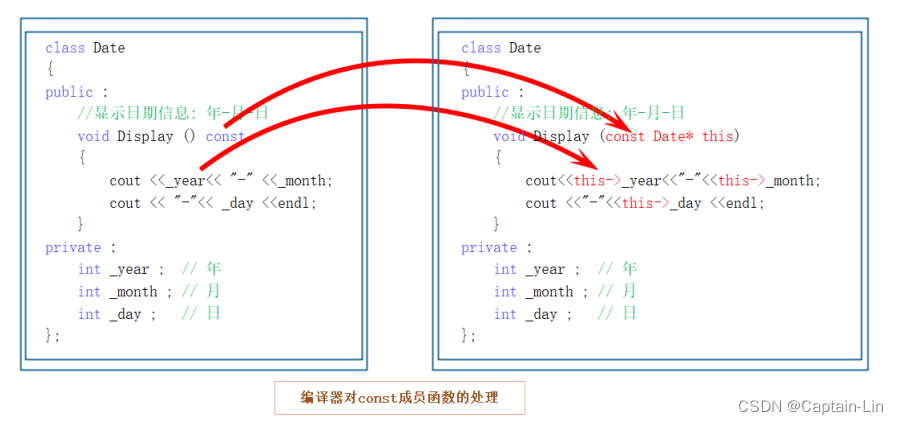
用const修饰的“成员函数”称之为const成员函数,const修饰类的成员函数,实际修饰该成员函数隐含的this指针,表明在该成员函数中不能对类的任何成员进行修改。
在下图中,左图和右图代表的含义实际上是相同的,我们可以将右图看为是作图的展开
下面我们一起看一段代码
class Date
{
public:Date(int year, int month, int day){_year = year;_month = month;_day = day;}void Print(){cout << "Print()" << endl;cout << "year:" << _year << endl;cout << "month:" << _month << endl;cout << "day:" << _day << endl << endl;}void Print() const{cout << "Print()const" << endl;cout << "year:" << _year << endl;cout << "month:" << _month << endl;cout << "day:" << _day << endl << endl;}
private:int _year; // 年int _month; // 月int _day; // 日
};int main()
{Date d1(2022, 1, 13);d1.Print();const Date d2(2022, 1, 13);d2.Print();return 0;
}
它的输出结果如下
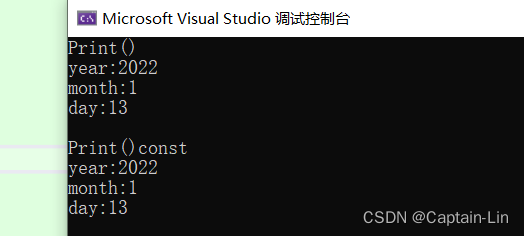
通过结果我们可以知,d2.Print() 和 d1.Print() 调用的函数并不相同,因为在定义 Date d2时,在前面加上了const ,因此调用的函数不能更改 d2,否则就造成了权限放大,编译器报错,所以编译器会默认调用 void Print() const 函数。
接下来我们思考一个问题,不要 void Print() 函数可不可以呢?答案是当然可以,默认允许更改->不能更改,实际上时权限的缩小
光说不练假把式,我们直接编译一下
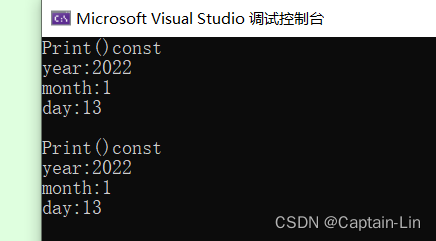
从编译结果得证:调用类函数允许权限缩小和平移,不允许权限缩小
接下来我们再看一组练习强化理解一下:
1. const对象可以调用非const成员函数吗?
2. 非const对象可以调用const成员函数吗?
3. const成员函数内可以调用其它的非const成员函数吗?
4. 非const成员函数内可以调用其它的const成员函数吗?
答案:
1、const对象不能调用非const成员函数,const对象可以调用const成员函数
2、非const对象可以调用const成员函数,非const对象可以调用非const成员函数
3、const成员函数不能调用非const成员函数
4、非const成员函数可以调用非const成员函数
因此,当我们在使用成员函数需要某些限制时,const成员的作用就凸显出来了。
四、取地址及const取地址操作符重载
之前我们就介绍过,类里面有6个默认函数,前四个(构造、析构、拷贝、赋值重载)我们都在前面的博客详细解说过了,今天我们就继续来谈谈最后两个默认函数,取地址及const取地址操作符重载。
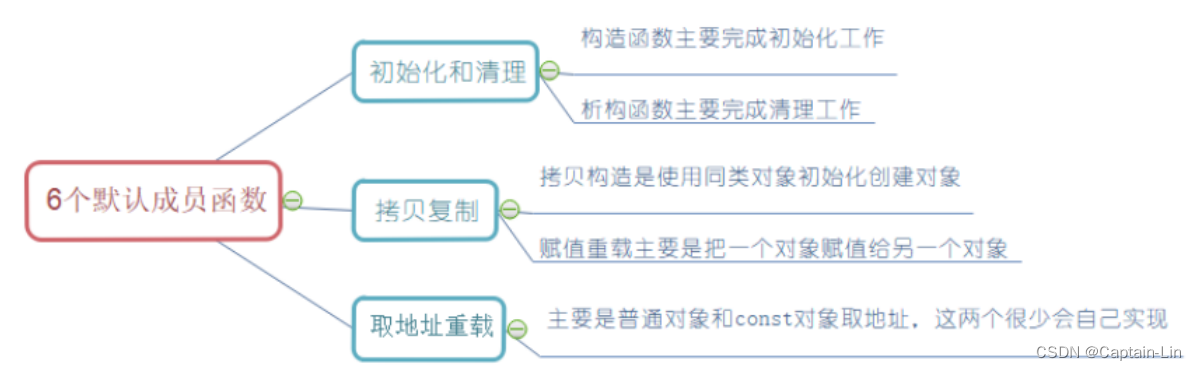
事实上,取地址及const取地址操作符重载,这两种默认函数需要我们显式实现的情况少之又少,编译器已经基本帮我们准备好了。所以我们简单了解一下即可。
class Date
{
public:Date* operator&()    //取地址操作符重载{return this;}const Date* operator&()const    //const取地址操作符重载{return this;}
private:int _year; // 年int _month; // 月int _day; // 日
};
这两个运算符一般不需要重载,使用编译器生成的默认取地址的重载即可,只有特殊情况,才需
要重载,比如想让别人获取到指定的内容!
🌹🌹今天的内容大概就讲到这里啦,博主后续会继续向大家介绍更多实用有趣的工具,干货满满,如果觉得博主写的还不错的话,希望各位小伙伴不要吝啬手中的三连哦!你们的支持是博主坚持创作的动力!💪💪