

深度探讨react-hooks实现原理
react hooks 实现
Hooks 解决了什么问题
在 React 的设计哲学中,简单的来说可以用下面这条公式来表示:
UI = f(data)
等号的左边时 UI 代表的最终画出来的界面;等号的右边是一个函数,也就是我们写的 React 相关的代码;data 就是数据,在 React 中,data 可以是 state 或者 props。
UI 就是把 data 作为参数传递给 f 运算出来的结果。这个公式的含义就是,如果要渲染界面,不要直接去操纵 DOM 元素,而是修改数据,由数据去驱动 React 来修改界面。
我们开发者要做的,就是设计出合理的数据模型,让我们的代码完全根据数据来描述界面应该画成什么样子,而不必纠结如何去操作浏览器中的 DOM 树结构。
总体的设计原则:
- 界面完全由数据驱动
- 一切皆组件
- 使用 props 进行组件之间通讯
与之带来的问题有哪些呢?
- 组件之间数据交流耦合度过高,许多组件之间需要共享的数据需要层层的传递;传统的解决方式呢!
- 变量提升
- 高阶函数透传
- 引入第三方数据管理库,redux、mobx
- 以上三种设计方式都是,都是将数据提升至父节点或者最高节点,然后数据层层传递
- ClassComponet 生命周期的学习成本,以及强关联的代码逻辑由于生命周期钩子函数的执行过程,需要将代码进行强行拆分;常见的:
class SomeCompoent extends Component {componetDidMount() {const node = this.refs['myRef'];node.addEventListener('mouseDown', handlerMouseDown);node.addEventListener('mouseUp', handlerMouseUp)}...componetWillunmount() {const node = this.refs['myRef'];node.removeEventListener('mouseDown', handlerMouseDown)node.removeEventListener('mouseUp', handlerMouseUp)}
}
可以说 Hooks 的出现上面的问题都会迎刃而解
Hooks API 类型
据官方声明,hooks 是完全向后兼容的,class componet 不会被移除,作为开发者可以慢慢迁移到最新的 API。
Hooks 主要分三种:
- State hooks : 可以让 function componet 使用 state
- Effect hooks : 可以让 function componet 使用生命周期和 side effect
- Custom hooks: 根据 react 提供的 useState、useReducer、useEffect、useRef等自定义自己需要的 hooks
下面我们来了解一下 Hooks。
首先接触到的是 State hooks
useState 是我们第一个接触到 React Hooks,其主要作用是让 Function Component 可以使用 state,接受一个参数做为 state 的初始值,返回当前的 state 和 dispatch。
import { useState } from 'react';function Example() {// Declare a new state variable, which we'll call "count"const [count, setCount] = useState(0);return (You clicked {count} times
);
}
其中 useState 可以多次声明;
function FunctionalComponent () {const [state1, setState1] = useState(1)const [state2, setState2] = useState(2)const [state3, setState3] = useState(3)return {state1}{...}
}
与之对应的 hooks 还有 useReducer,如果是一个状态对应不同类型更新处理,则可以使用 useReducer。
其次接触到的是 Effect hooks
useEffect 的使用是让 Function Componet 组件具备 life-cycles 声明周期函数;比如 componetDidMount、componetDidUpdate、shouldCompoentUpdate 以及 componetWiillunmount 都集中在这一个函数中执行,叫 useEffect。这个函数有点类似 Redux 的 subscribe,会在每次 props、state 触发 render 之后执行。(在组件第一次 render和每次 update 后触发)。
为什么叫 useEffect 呢?官方的解释:因为我们通常在生命周期内做很多操作都会产生一些 side-effect (副作用) 的操作,比如更新 DOM,fetch 数据等。
useEffect 是使用:
import React, { useState, useEffect } from 'react';function useMousemove() {const [client, setClient] = useState({x: 0, y: 0});useEffect(() => {const handlerMouseCallback = (e) => {setClient({x: e.clientX,y: e.clientY})};// 在组件首次 render 之后, 既在 didMount 时调用document.addEventListener('mousemove', handlerMouseCallback, false);return () => {// 在组件卸载之后执行document.removeEventListener('mousemove', handlerMouseCallback, false);}})return client;
}
其中 useEffect 只是在组件首次 render 之后即 didMount 之后调用的,以及在组件卸载之时即 unmount 之后调用,如果需要在 DOM 更新之后同步执行,可以使用 useLayoutEffect。
最后接触到的是 custom hooks
根据官方提供的 useXXX API 结合自己的业务场景,可以使用自定义开发需要的 custom hooks,从而抽离业务开发数据,按需引入;实现业务数据与视图数据的充分解耦。
参考React实战视频讲解:进入学习
Hooks 实现方式
在上面的基础之后,对于 hooks 的使用应该有了基本的了解,下面我们结合 hooks 源码对于 hooks 如何能保存无状态组件的原理进行剥离。
Hooks 源码在 Reactreact-reconclier** 中的 ReactFiberHooks.js ,代码有 600 行,理解起来也是很方便的
Hooks 的基本类型:
type Hooks = {memoizedState: any, // 指向当前渲染节点 FiberbaseState: any, // 初始化 initialState, 已经每次 dispatch 之后 newStatebaseUpdate: Update | null,// 当前需要更新的 Update ,每次更新完之后,会赋值上一个 update,方便 react 在渲染错误的边缘,数据回溯queue: UpdateQueue | null,// UpdateQueue 通过next: Hook | null, // link 到下一个 hooks,通过 next 串联每一 hooks
}type Effect = {tag: HookEffectTag, // effectTag 标记当前 hook 作用在 life-cycles 的哪一个阶段create: () => mixed, // 初始化 callbackdestroy: (() => mixed) | null, // 卸载 callbackdeps: Array | null,next: Effect, // 同上
};
React Hooks 全局维护了一个 workInProgressHook 变量,每一次调取 Hooks API 都会首先调取 createWorkInProgressHooks 函数。
function createWorkInProgressHook() {if (workInProgressHook === null) {// This is the first hook in the listif (firstWorkInProgressHook === null) {currentHook = firstCurrentHook;if (currentHook === null) {// This is a newly mounted hookworkInProgressHook = createHook();} else {// Clone the current hook.        workInProgressHook = cloneHook(currentHook);}firstWorkInProgressHook = workInProgressHook;} else {// There's already a work-in-progress. Reuse it.      currentHook = firstCurrentHook;workInProgressHook = firstWorkInProgressHook;}} else {if (workInProgressHook.next === null) {let hook;if (currentHook === null) {// This is a newly mounted hookhook = createHook();} else {currentHook = currentHook.next;if (currentHook === null) {// This is a newly mounted hookhook = createHook();} else {// Clone the current hook.          hook = cloneHook(currentHook);}}// Append to the end of the listworkInProgressHook = workInProgressHook.next = hook;} else {// There's already a work-in-progress. Reuse it.      workInProgressHook = workInProgressHook.next;currentHook = currentHook !== null ? currentHook.next : null;}}return workInProgressHook;
}
假设我们需要执行以下 hooks 代码:
function FunctionComponet() {const [ state0, setState0 ] = useState(0);const [ state1, setState1 ] = useState(1);useEffect(() => {document.addEventListener('mousemove', handlerMouseMove, false);.........return () => {.........document.removeEventListener('mousemove', handlerMouseMove, false);}})const [ satte3, setState3 ] = useState(3);return [state0, state1, state3];
}
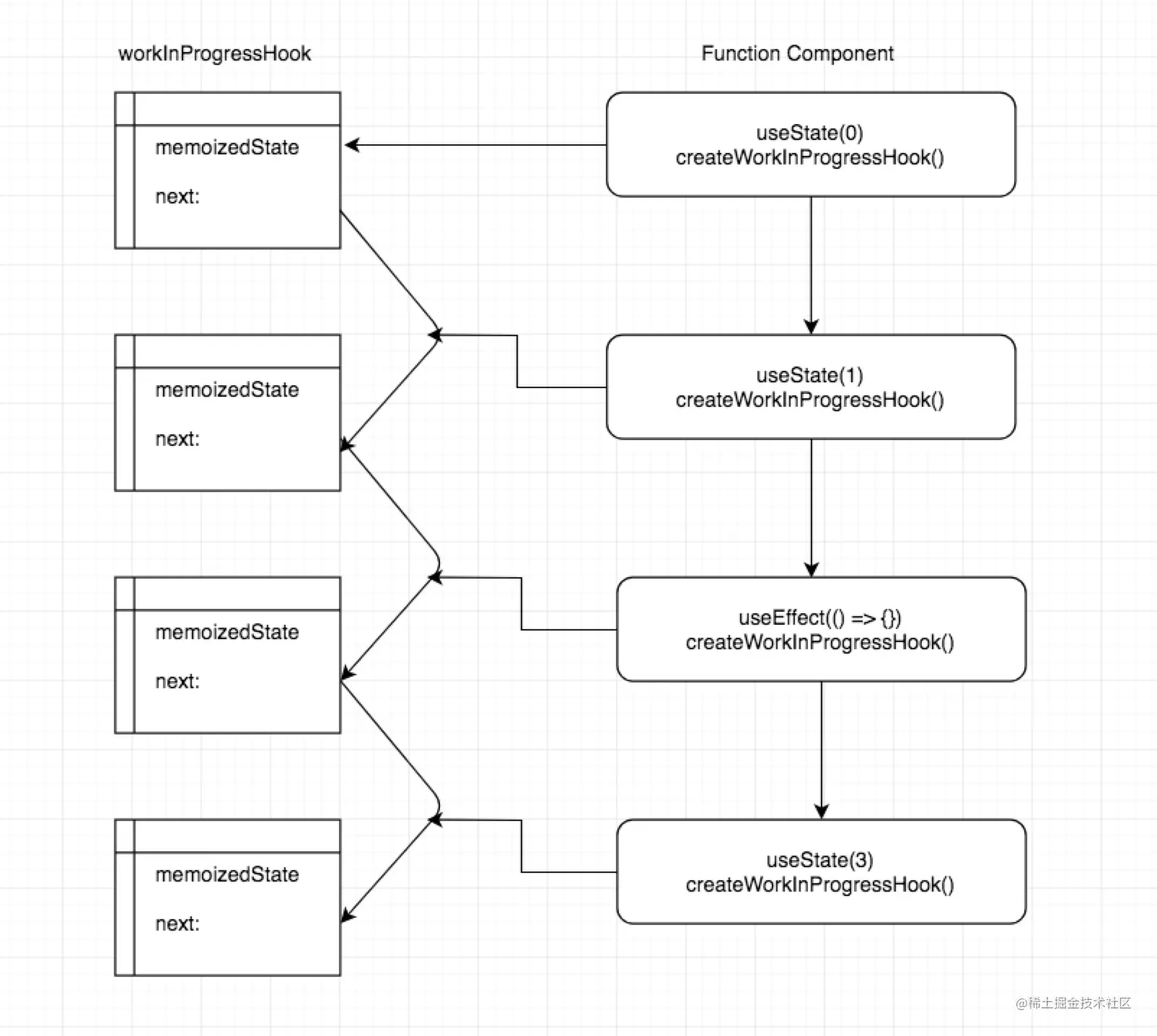
当我们了解 React Hooks 的简单原理,得到 Hooks 的串联不是一个数组,但是是一个链式的数据结构,从根节点 workInProgressHook 向下通过 next 进行串联。这也就是为什么 Hooks 不能嵌套使用,不能在条件判断中使用,不能在循环中使用。否则会破坏链式结构。
问题一:useState dispatch 函数如何与其使用的 Function Component 进行绑定
下面我们先看一段代码:
import React, { useState, useEffect } from 'react';
import ReactDOM from 'react-dom';const useWindowSize = () => {let [size, setSize] = useState([window.innerWidth, window.innerHeight])useEffect(() => {let handleWindowResize = event => {setSize([window.innerWidth, window.innerHeight])}window.addEventListener('resize', handleWindowResize)return () => window.removeEventListener('resize', handleWindowResize)}, [])return size
}const App = () => {const [ innerWidth, innerHeight ] = useWindowSize();return (- innerWidth: {innerWidth}
- innerHeight: {innerHeight}
)
}ReactDOM.render(useState 的作用是让 Function Component 具备 State 的能力,但是对于开发者来讲,只要在 Function Component 中引入了 hooks 函数,dispatch 之后就能够作用就能准确的作用在当前的组件上,不经意会有此疑问,带着这个疑问,阅读一下源码。
function useState(initialState){ return useReducer(basicStateReducer, // useReducer has a special case to support lazy useState initializers (initialState: any), );}function useReducer(reducer, initialState, initialAction) { // 解析当前正在 rendering 的 Fiberlet fiber = (currentlyRenderingFiber = resolveCurrentlyRenderingFiber()); workInProgressHook = createWorkInProgressHook(); // 此处省略部分源码 ... ... ... // dispathAction 会绑定当前真在渲染的 Fiber, 重点在 dispatchAction 中 const dispatch = dispatchAction.bind(null, currentlyRenderingFiber,queue,) return [workInProgressHook.memoizedState, dispatch];}function dispatchAction(fiber, queue, action) { const alternate = fiber.alternate; const update: Update = { expirationTime, action, eagerReducer: null, eagerState: null, next: null, }; ...... ...... ...... scheduleWork(fiber, expirationTime);}
下一篇:互相帮助,误入仙家碧玉壶