

服务端Skynet(二)——消息调度机制
服务端Skynet(二)——消息调度机制
文章目录
- 服务端Skynet(二)——消息调度机制
- 1、提前了解知识
- 1.1、互斥锁(mutex lock : **mut**ual **ex**clusion lock)
- 1.2、自旋锁(spinlock)
- 1.3、读写锁(readers–writer lock)
- 1.4、条件变量(condition variables)
- 2、消息的数据结构
- 3、消费消息流程
- 4、生成消息流程
- 5、监管机制
参考文献:
skynet设计综述
skynet源码赏析
1、提前了解知识
1.1、互斥锁(mutex lock : mutual exclusion lock)
- 概念:互斥锁,一条线程加锁锁住临界区,另一条线程尝试访问该临界区的时候,会发生阻塞,并进入休眠状态。临界区是锁lock和unlock之间的代码片段,一般是多条线程能够共同访问的部分。
- 具体说明:假设一台机器上的cpu有两个核心core0和core1,现在有线程A、B、C,此时core0运行线程A,core1运行线程B,此时线程B使用Mutex锁,锁住一个临界区,当线程A试图访问该临界区时,因为线程B已经将其锁住,因此线程A被挂起,进入休眠状态,此时core0进行上下文切换,将线程A放入休眠队列中,然后core0运行线程C,当线程B完成临界区的流程并执行解锁之后,线程A又会被唤醒,core0重新运行线程A
1.2、自旋锁(spinlock)
- 概念:自旋锁,一条线程加锁锁住临界区,另一条线程尝试访问该临界区的时候,会发生阻塞,但是不会进入休眠状态,并且不断轮询该锁,直至原来锁住临界区的线程解锁。
- 具体说明:假设一台机器上有两个核心core0和core1,现在有线程A、B、C,此时core0运行线程A,core1运行线程B,此时线程B调用spin lock锁住临界区,当线程A尝试访问该临界区时,因为B已经加锁,此时线程A会阻塞,并且不断轮询该锁,不会交出core0的使用权,当线程B释放锁时,A开始执行临界区逻辑
1.3、读写锁(readers–writer lock)
- 概述:读写锁,一共三种状态
- 读状态时加锁,此时为共享锁,当一个线程加了读锁时,其他线程如果也尝试以读模式进入临界区,那么不会发生阻塞,直接访问临界区
- 写状态时加锁,此时为独占锁,当某个线程加了写锁,那么其他线程尝试访问该临界区(不论是读还是写),都会阻塞等待
- 不加锁
- 注意:
- 某线程加读取锁时,允许其他线程以读模式进入,此时如果有一个线程尝试以写模式访问临界区时,该线程会被阻塞,而其后尝试以读方式访问该临界区的线程也会被阻塞
- 读写锁适合在读远大于写的情形中使用
1.4、条件变量(condition variables)
- 概述:条件变量是利用线程间共享的变量进行同步的一种机制,是在多线程程序中用来实现"等待–>唤醒"逻辑常用的方法,用于维护一个条件(与是条件变量不同的概念),线程可以使用条件变量来等待某个条件为真,注意理解并不是等待条件变量为真。当条件不满足时,线程将自己加入等待队列,同时释放持有的互斥锁; 当一个线程唤醒一个或多个等待线程时,此时条件不一定为真(虚假唤醒)。
- 具体说明:应用程序A中包含两个线程t1和t2。t1需要在bool变量test_cond为true时才能继续执行,而test_cond的值是由t2来改变的。t1在test_cond为false时调用cond_wait进行等待,t2在改变test_cond的值后,调用cond_signal,唤醒在等待中的t1,告诉t1 test_cond的值变了,这样t1便可继续往下执行。
2、消息的数据结构
skynet 中一共支持两种不同的消息:
- skynet_message 本地消息
- remote_message 远程消息
//skynet_mq.h
struct skynet_message {uint32_t source; 	//源地址(发送的)int session;	    //当一个服务向另一个服务发请求是会生成一个session(包含请求数据的结构体),当响应端处理完毕之后,将结果放到session 原样返回void * data;size_t sz;
};//skynet_harbor.h
#define GLOBALNAME_LENGTH 16
#define REMOTE_MAX 256//remote_name 远程节点(skynet) 名称
struct remote_name {char name[GLOBALNAME_LENGTH];uint32_t handle;
};struct remote_message {struct remote_name destination;const void * message;size_t sz;int type;
};
3、消费消息流程
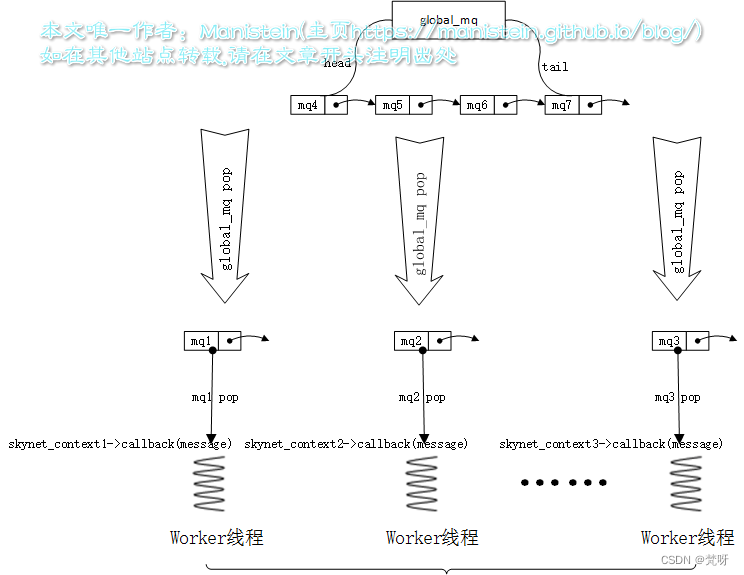
skynet在启动时,会创建若干条worker线程(由配置指定),这些worker线程被创建以后,会不断得从global_mq里pop出一个次级消息队列来,每个worker线程,每次只pop一个次级消息队列,然后再从次级消息队列中,pop一到若干条消息出来(受权重值影响),最后消息将作为参数传给对应服务的callback函数(每个服务只有一个专属的次级消息队列),当callback执行完时,worker线程会将次级消息队列push回global_mq里,这样就完成了消息的消费。在这个过程中,因为每个worker线程会从global_mq里pop一个次级消息队列出来,此时其他worker线程就不能从global_mq里pop出同一个次级消息队列,也就是说,一个服务不能在多个worker线程内调用callback函数,从而保证了线程安全。大致框图如下:
其中线程池中的前三个线程是 monitor, timer 和 socket 线程。其中,monitor 线程主要负责检查每个服务是否陷入了死循环,socket 线程负责网络相关操作,timer 线程则负责定时器。worker 具有不同的权重值,每个 worker 会不断从全局消息队列中取出某个服务的次级消息队列,并根据权重值的不同从消息队列中取出若干个消息,然后调用服务所属的 callback 函数消费消息。创建流程源码:
//skynet_start.c
static void
start(int thread) {pthread_t pid[thread+3];struct monitor *m = skynet_malloc(sizeof(*m));memset(m, 0, sizeof(*m));m->count = thread;m->sleep = 0;m->m = skynet_malloc(thread * sizeof(struct skynet_monitor *));int i;for (i=0;im->m[i] = skynet_monitor_new();}if (pthread_mutex_init(&m->mutex, NULL)) {fprintf(stderr, "Init mutex error");exit(1);}if (pthread_cond_init(&m->cond, NULL)) {fprintf(stderr, "Init cond error");exit(1);}//创建monitor, timer 和 socket 线程create_thread(&pid[0], thread_monitor, m);create_thread(&pid[1], thread_timer, m);create_thread(&pid[2], thread_socket, m);//worker 线程的权重值
/*-1:从次级消息队列取出一个消息进行处理0:从次级消息队列取出所有消息进行处理当权重>0时,假设次级消息队列的长度为mq_length,将mq_length转成二进制数值以后,向右移动weight(权重值)位,结果N则是,该线程一次消费次级消息队列的消息数:1:从次级消息队列取出一半的消息进行处理2:从次级消息队列取出四分之一的消息进行处理3:从次级消息队列取出八分之一的消息进行处理这样做的目的,大概是希望避免过多的worker线程为了等待spinlock解锁,而陷入阻塞状态(因为一些线程,一次消费多条甚至全部次级消息队列的消息,因此在消费期间,不会对global_mq进行入队和出队操作,入队和出队操作时加自旋锁的,因此就不会尝试去访问spinlock锁住的临界区,该线程就在相当一段时间内不会陷入阻塞),进而提升服务器的并发处理能力。这里还有一个细节值得注意,就是前四条线程,每次只是pop一个次级消息队列的消息出来,这样做也在一定程度上保证了没有服务会被饿死。
*/static int weight[] = { -1, -1, -1, -1, 0, 0, 0, 0,1, 1, 1, 1, 1, 1, 1, 1, 2, 2, 2, 2, 2, 2, 2, 2, 3, 3, 3, 3, 3, 3, 3, 3, };//创建相应数量的 worker 线程struct worker_parm wp[thread];for (i=0;iwp[i].m = m;wp[i].id = i;if (i < sizeof(weight)/sizeof(weight[0])) {wp[i].weight= weight[i];} else {wp[i].weight = 0;}create_thread(&pid[i+3], thread_worker, &wp[i]);}for (i=0;ipthread_join(pid[i], NULL); }free_monitor(m);
}
在多条线程,同时运作时,每条worker线程都要从global_mq中pop一条次级消息队列出来,对global_mq进行pop和push操作的时候,会用自旋锁锁住临界区
// skynet_mq.c
void
skynet_globalmq_push(struct message_queue * queue) {struct global_queue *q= Q;SPIN_LOCK(q) //自旋锁assert(queue->next == NULL);if(q->tail) {q->tail->next = queue;q->tail = queue;} else {q->head = q->tail = queue;}SPIN_UNLOCK(q)
}struct message_queue *
skynet_globalmq_pop() {struct global_queue *q = Q;SPIN_LOCK(q)struct message_queue *mq = q->head;if(mq) {q->head = mq->next;if(q->head == NULL) {assert(mq == q->tail);q->tail = NULL;}mq->next = NULL;}SPIN_UNLOCK(q)return mq;
}
正如本节概述所说,一个worker线程被创建出来以后,则是不断尝试从global_mq中pop一个次级消息队列,并从次级消息队列中pop消息,进而通过服务的callback函数来消费该消息:
// skynet_start.c
static void
wakeup(struct monitor *m, int busy) {if (m->sleep >= m->count - busy) {// signal sleep worker, "spurious wakeup" is harmlesspthread_cond_signal(&m->cond);}
}static void *
thread_timer(void *p) {struct monitor * m = p;skynet_initthread(THREAD_TIMER);for (;;) {skynet_updatetime();CHECK_ABORTwakeup(m,m->count-1);usleep(2500);}// wakeup socket threadskynet_socket_exit();// wakeup all worker threadpthread_mutex_lock(&m->mutex);m->quit = 1;pthread_cond_broadcast(&m->cond);pthread_mutex_unlock(&m->mutex);return NULL;
}static void *
thread_worker(void *p) {struct worker_parm *wp = p;int id = wp->id;int weight = wp->weight;struct monitor *m = wp->m;struct skynet_monitor *sm = m->m[id];skynet_initthread(THREAD_WORKER);struct message_queue * q = NULL;while (!m->quit) {q = skynet_context_message_dispatch(sm, q, weight);if (q == NULL) {if (pthread_mutex_lock(&m->mutex) == 0) {++ m->sleep;// "spurious wakeup" is harmless,// because skynet_context_message_dispatch() can be call at any time.if (!m->quit)pthread_cond_wait(&m->cond, &m->mutex);-- m->sleep;if (pthread_mutex_unlock(&m->mutex)) {fprintf(stderr, "unlock mutex error");exit(1);}}}}return NULL;
}// skynet_server.c
struct message_queue *
skynet_context_message_dispatch(struct skynet_monitor *sm, struct message_queue *q, int weight) {if (q == NULL) {q = skynet_globalmq_pop();if (q==NULL)return NULL;}uint32_t handle = skynet_mq_handle(q);struct skynet_context * ctx = skynet_handle_grab(handle);if (ctx == NULL) {struct drop_t d = { handle };skynet_mq_release(q, drop_message, &d);return skynet_globalmq_pop();}int i,n=1;struct skynet_message msg;for (i=0;iif (skynet_mq_pop(q,&msg)) {skynet_context_release(ctx);return skynet_globalmq_pop();} else if (i==0 && weight >= 0) {n = skynet_mq_length(q);n >>= weight;}int overload = skynet_mq_overload(q);if (overload) {skynet_error(ctx, "May overload, message queue length = %d", overload);}skynet_monitor_trigger(sm, msg.source , handle);if (ctx->cb == NULL) {skynet_free(msg.data);} else {dispatch_message(ctx, &msg);}skynet_monitor_trigger(sm, 0,0);}assert(q == ctx->queue);struct message_queue *nq = skynet_globalmq_pop();if (nq) {// If global mq is not empty , push q back, and return next queue (nq)// Else (global mq is empty or block, don't push q back, and return q again (for next dispatch)skynet_globalmq_push(q);q = nq;} skynet_context_release(ctx);return q;
}static void
dispatch_message(struct skynet_context *ctx, struct skynet_message *msg) {assert(ctx->init);CHECKCALLING_BEGIN(ctx)pthread_setspecific(G_NODE.handle_key, (void *)(uintptr_t)(ctx->handle));int type = msg->sz >> MESSAGE_TYPE_SHIFT;size_t sz = msg->sz & MESSAGE_TYPE_MASK;if (ctx->logfile) {skynet_log_output(ctx->logfile, msg->source, type, msg->session, msg->data, sz);}if (!ctx->cb(ctx, ctx->cb_ud, type, msg->session, msg->source, msg->data, sz)) {skynet_free(msg->data);} CHECKCALLING_END(ctx)
}
整个worker线程的消费流程是:
a) worker线程每次,从global_mq中弹出一个次级消息队列,如果次级消息队列为空,则该worker线程投入睡眠,timer线程每隔2.5毫秒会唤醒一条睡眠中的worker线程,并重新尝试从全局消息队列中pop一个次级消息队列出来,当次级消息队列不为空时,进入下一步
b) 根据次级消息的handle,找出其所属的服务(一个skynet_context实例)指针,从次级消息队列中,pop出n条消息(受weight值影响),并且将其作为参数,传给skynet_context的cb函数,并调用它
c) 当完成callback函数调用时,就从global_mq中再pop一个次级消息队列中,供下一次使用,并将本次使用的次级消息队列push回global_mq的尾部
d) 返回第a步
线程安全:
1、整个消费流程,每条worker线程,从global_mq取出的次级消息队列都是唯一的,并且有且只有一个服务与之对应,取出之后,在该worker线程完成所有callback调用之前,不会push回global_mq中,也就是说,在这段时间内,其他worker线程不能拿到这个次级消息队列所对应的服务,并调用callback函数,也就是说一个服务不可能同时在多条worker线程内执行callback函数,从而保证了线程安全。
2、不论是global_mq也好,次级消息队列也好,他们在入队和出队操作时,都有加上spinlock,这样多个线程同时访问mq的时候,第一个访问者会进入临界区并锁住,其他线程会阻塞等待,直至该锁解除,这样也保证了线程安全。global_mq会同时被多个worker线程访问,这个很好理解,因为worker线程总是在不断尝试驱动不同的服务,要驱动服务,首先要取出至少一个消息,要获得消息,就要取出一个次级消息队列,而这个次级消息队列要从全局消息队列里取。虽然一个服务的callback函数,只能在一个worker线程内被调用,但是在多个worker线程中,可以向同一个次级消息队列push消息,即便是该次级消息队列所对应的服务正在执行callback函数,由于次级消息队列不是skynet_context的成员(skynet_context只是包含了次级消息队列的指针),因此改变次级消息队列不等于改变skynet_context上的数据,不会影响到该服务自身内存的数据,次级消息队列在进行push和pop操作的时候,会加上一个spinlock,当多个worker线程同时向同一个次级消息队列push消息时,第一个访问的worker线程,能够进入临界区,其他worker线程就阻塞等待,直至该临界区解锁,这样保证了线程安全。
3、我们在通过handle从skynet_context list里获取skynet_context的过程中(比如派发消息时,要要先获取skynet_context指针,再调用该服务的callback函数),需要加上一个读写锁,因为在skynet运作的过程中,获取skynet_context,比创建skynet_context的情况要多得多,因此这里用了读写锁:
struct skynet_context *
skynet_handle_grab(uint32_t handle) {struct handle_storage *s = H;struct skynet_context * result = NULL;rwlock_rlock(&s->lock);uint32_t hash = handle & (s->slot_size-1);struct skynet_context * ctx = s->slot[hash];if (ctx && skynet_context_handle(ctx) == handle) {result = ctx;skynet_context_grab(result);}rwlock_runlock(&s->lock);return result;
}
这里加上读写锁的意义在于,多个worker线程,同时从skynet_context列表中获取context指针时,没有一条线程是会被阻塞的,这样提高了并发的效率,而此时,尝试往skyent_context里表中,添加新的服务的线程将会被阻塞住,因为添加新的服务可能会导致skynet_context列表(也就是代码里的slot列表)可能会被resize,因此读的时候不允许写入,写的时候不允许读取,保证了线程安全。
4、生成消息流程
skynet 中不同的服务运行在不同的上下文当中,彼此之间的交互只能通过消息队列进行转发。不同服务之间转发消息的接口为 skynet_send ,其定义如下:
//skynet_server.c
int
skynet_send(struct skynet_context * context, uint32_t source, uint32_t destination , int type, int session, void * data, size_t sz) {if ((sz & MESSAGE_TYPE_MASK) != sz) {skynet_error(context, "The message to %x is too large", destination);if (type & PTYPE_TAG_DONTCOPY) {skynet_free(data);}return -2;}//type类型确定消息格式 // PTYPE_TAG_ALLOCSESSION  	分配 新session							*session = skynet_context_newsession(context);// PTYPE_TAG_DONTCOPY 		不要拷贝data,在data上直接处理		_filter_args(context, type, &session, (void **)&data, &sz);//消息发送端if (source == 0) {source = context->handle;}//消息接收端if (destination == 0) {if (data) {skynet_error(context, "Destination address can't be 0");skynet_free(data);return -1;}return session;}/*skynet_harbor_send 和 skynet_context_push --> skynet_mq_push skynet发消息的实质是往服务的次级消息队列压入消息*/if (skynet_harbor_message_isremote(destination)) {struct remote_message * rmsg = skynet_malloc(sizeof(*rmsg));rmsg->destination.handle = destination;rmsg->message = data;rmsg->sz = sz & MESSAGE_TYPE_MASK;rmsg->type = sz >> MESSAGE_TYPE_SHIFT;skynet_harbor_send(rmsg, source, session);} else {struct skynet_message smsg;smsg.source = source;smsg.session = session;smsg.data = data;smsg.sz = sz;if (skynet_context_push(destination, &smsg)) {skynet_free(data);return -1;}}return session;
}
5、监管机制
1、定义结构体
//skynet_monitor.c
struct skynet_monitor {ATOM_INT version;		//版本int check_version;		//旧版本uint32_t source;		//源地址uint32_t destination;	//目标地址
};//skynet_start.c
struct monitor {int count;					//monitor监管的 工作线程数量struct skynet_monitor ** m;	 //数组  存放所有的skynet_monitor   一个worker对应一个skynet_monitorpthread_cond_t cond;pthread_mutex_t mutex;int sleep;int quit;
};
2、运行函数
/*skynet_start.c	thread_monitor每隔一段时间(5s) 对每个worker线程都执行一次 skynet_monitor_check工作流程:worker 从global_mq取出次级消息队列进行消费  执行dispatch_message(ctx, &msg); 会先调用skynet_monitor_trigger函数 添加skynet_monitor此时skynet_monitor状态:skynet_monitor->version = 1; skynet_monitor->check_version = 0;当monitor 对skynet_monitor执行 skynet_monitor_check函数 此时skynet_monitor_check(第一次)中 sm->version == sm->check_version == 1当worker 陷入死循环达到(第二次)skynet_monitor_check 因为sm->version == sm->check_version成立 返回一条错误日志当worker 在(第二次)skynet_monitor_check之前的时间(5s)处理完消息,此时sm->source 和 sm->destination 都设置为0*/
static void *
thread_monitor(void *p) {struct monitor * m = p;int i;int n = m->count;skynet_initthread(THREAD_MONITOR);for (;;) {CHECK_ABORTfor (i=0;iskynet_monitor_check(m->m[i]);}for (i=0;i<5;i++) {CHECK_ABORTsleep(1);}}return NULL;
}// skynet_monitor.c   skynet_monitor_check
void
skynet_monitor_check(struct skynet_monitor *sm) {if (sm->version == sm->check_version) {if (sm->destination) { //检查目标地址是否为0skynet_context_endless(sm->destination);skynet_error(NULL, "A message from [ :%08x ] to [ :%08x ] maybe in an endless loop (version = %d)", sm->source , sm->destination, sm->version);}} else {sm->check_version = sm->version;}
}/*	那worker怎么添加monitor?thread_worker --> skynet_context_message_dispatch --> skynet_monitor_trigger(sm, msg.source , handle);
*/
struct message_queue *
skynet_context_message_dispatch(struct skynet_monitor *sm, struct message_queue *q, int weight) {if (q == NULL) {q = skynet_globalmq_pop();if (q==NULL)return NULL;}uint32_t handle = skynet_mq_handle(q);struct skynet_context * ctx = skynet_handle_grab(handle);if (ctx == NULL) {struct drop_t d = { handle };skynet_mq_release(q, drop_message, &d);return skynet_globalmq_pop();}int i,n=1;struct skynet_message msg;for (i=0;iif (skynet_mq_pop(q,&msg)) {skynet_context_release(ctx);return skynet_globalmq_pop();} else if (i==0 && weight >= 0) {n = skynet_mq_length(q);n >>= weight;}int overload = skynet_mq_overload(q);if (overload) {skynet_error(ctx, "May overload, message queue length = %d", overload);}skynet_monitor_trigger(sm, msg.source , handle);if (ctx->cb == NULL) {skynet_free(msg.data);} else {dispatch_message(ctx, &msg);}skynet_monitor_trigger(sm, 0,0);}assert(q == ctx->queue);struct message_queue *nq = skynet_globalmq_pop();if (nq) {// If global mq is not empty , push q back, and return next queue (nq)// Else (global mq is empty or block, don't push q back, and return q again (for next dispatch)skynet_globalmq_push(q);q = nq;} skynet_context_release(ctx);return q;
}void
skynet_monitor_trigger(struct skynet_monitor *sm, uint32_t source, uint32_t destination) {sm->source = source;sm->destination = destination;ATOM_FINC(&sm->version);
}