

8、如何使用FactoryBean向Spring容器中注册bean?
📫作者简介:zhz小白
公众号:小白的Java进阶之路
专业技能:
1、Java基础,并精通多线程的开发,熟悉JVM原理
2、熟悉Java基础,并精通多线程的开发,熟悉JVM原理,具备⼀定的线上调优经验
3、熟悉MySQL数据库调优,索引原理等,⽇志原理等,并且有出过⼀篇专栏
4、了解计算机⽹络,对TCP协议,滑动窗⼝原理等有⼀定了解
5、熟悉Spring,Spring MVC,Mybatis,阅读过部分Spring源码
6、熟悉SpringCloud Alibaba体系,阅读过Nacos,Sentinel,Seata,Dubbo,Feign,Gateway核⼼源码与设计,⼆次开发能⼒
7、熟悉消息队列(Kafka,RocketMQ)的原理与设计
8、熟悉分库分表ShardingSphere,具有真实⽣产的数据迁移经验
9、熟悉分布式缓存中间件Redis,对其的核⼼数据结构,部署架构,⾼并发问题解决⽅案有⼀定的积累
10、熟悉常⽤设计模式,并运⽤于实践⼯作中
11、了解ElasticSearch,对其核⼼的原理有⼀定的了解
12、了解K8s,Jekins,GitLab
13、了解VUE,GO
14、⽬前有正在利⽤闲暇时间做互游游戏,开发、运维、运营、推销等
本人著作git项目:https://gitee.com/zhouzhz/star-jersey-platform,有兴趣的可以私聊博主一起编写,或者给颗star
领域:对支付(FMS,FUND,PAY),订单(OMS),出行行业等有相关的开发领域
🔥如果此文还不错的话,还请👍关注、点赞、收藏三连支持👍一下博主~
文章目录
- 1、定义
- 2、源码
- 2.1、分析
- 2.1.1、T getObject()
- 2.1.2、Class getObjectType()
- 2.1.3、boolean isSingleton()
- 2.2、案例
- 2.2.1、手写FactoryBean的实现类
- 2.2.2、在MainConfig注册TestFactoryBean
- 2.2.3、运行结果
- 2.2.4、疑问:怎么获取FactoryBean对象本身?加&
- 2.4.5、为什么加了&之后就能获取FactoryBean对象实例呢?
1、定义
- 一般情况下,Spring是通过反射机制利用bean的class属性指定实现类来实例化bean的。在某些情况下,实例化bean过程比较复杂,如果按照传统的方式,那么则需要在标签中提供大量的配置信息,配置方式的灵活性是受限的,这时采用编码的方式可以得到一个更加简单的方案。Spring为此提供了一个org.springframework.bean.factory.FactoryBean的工厂类接口,用户可以通过实现该接口定制实例化bean的逻辑。
- 简单理解为我们可以自己创造Bean,不需要通过BeanPostProcessor来干涉Spring创建bean的过程(factorybean创建的bean只会经过初始化后,其他Spring的生命周期不会经过)
2、源码
/** Copyright 2002-2020 the original author or authors.** Licensed under the Apache License, Version 2.0 (the "License");* you may not use this file except in compliance with the License.* You may obtain a copy of the License at**      https://www.apache.org/licenses/LICENSE-2.0** Unless required by applicable law or agreed to in writing, software* distributed under the License is distributed on an "AS IS" BASIS,* WITHOUT WARRANTIES OR CONDITIONS OF ANY KIND, either express or implied.* See the License for the specific language governing permissions and* limitations under the License.*/package org.springframework.beans.factory;import org.springframework.lang.Nullable;/*** Interface to be implemented by objects used within a {@link BeanFactory} which* are themselves factories for individual objects. If a bean implements this* interface, it is used as a factory for an object to expose, not directly as a* bean instance that will be exposed itself.** NB: A bean that implements this interface cannot be used as a normal bean.* A FactoryBean is defined in a bean style, but the object exposed for bean* references ({@link #getObject()}) is always the object that it creates.** FactoryBeans can support singletons and prototypes, and can either create* objects lazily on demand or eagerly on startup. The {@link SmartFactoryBean}* interface allows for exposing more fine-grained behavioral metadata.** This interface is heavily used within the framework itself, for example for* the AOP {@link org.springframework.aop.framework.ProxyFactoryBean} or the* {@link org.springframework.jndi.JndiObjectFactoryBean}. It can be used for* custom components as well; however, this is only common for infrastructure code.** {@code FactoryBean} is a programmatic contract. Implementations are not* supposed to rely on annotation-driven injection or other reflective facilities.* {@link #getObjectType()} {@link #getObject()} invocations may arrive early in the* bootstrap process, even ahead of any post-processor setup. If you need access to* other beans, implement {@link BeanFactoryAware} and obtain them programmatically.** The container is only responsible for managing the lifecycle of the FactoryBean* instance, not the lifecycle of the objects created by the FactoryBean. Therefore,* a destroy method on an exposed bean object (such as {@link java.io.Closeable#close()})* will not be called automatically. Instead, a FactoryBean should implement* {@link DisposableBean} and delegate any such close call to the underlying object.** Finally, FactoryBean objects participate in the containing BeanFactory's* synchronization of bean creation. There is usually no need for internal* synchronization other than for purposes of lazy initialization within the* FactoryBean itself (or the like).** @author Rod Johnson* @author Juergen Hoeller* @since 08.03.2003* @param  the bean type* @see org.springframework.beans.factory.BeanFactory* @see org.springframework.aop.framework.ProxyFactoryBean* @see org.springframework.jndi.JndiObjectFactoryBean*/
public interface FactoryBean {/*** The name of an attribute that can be* {@link org.springframework.core.AttributeAccessor#setAttribute set} on a* {@link org.springframework.beans.factory.config.BeanDefinition} so that* factory beans can signal their object type when it can't be deduced from* the factory bean class.* @since 5.2*/String OBJECT_TYPE_ATTRIBUTE = "factoryBeanObjectType";/*** Return an instance (possibly shared or independent) of the object* managed by this factory.* As with a {@link BeanFactory}, this allows support for both the* Singleton and Prototype design pattern.* If this FactoryBean is not fully initialized yet at the time of* the call (for example because it is involved in a circular reference),* throw a corresponding {@link FactoryBeanNotInitializedException}.* As of Spring 2.0, FactoryBeans are allowed to return {@code null}* objects. The factory will consider this as normal value to be used; it* will not throw a FactoryBeanNotInitializedException in this case anymore.* FactoryBean implementations are encouraged to throw* FactoryBeanNotInitializedException themselves now, as appropriate.* @return an instance of the bean (can be {@code null})* @throws Exception in case of creation errors* @see FactoryBeanNotInitializedException*/@NullableT getObject() throws Exception;/*** Return the type of object that this FactoryBean creates,* or {@code null} if not known in advance.* This allows one to check for specific types of beans without* instantiating objects, for example on autowiring.* In the case of implementations that are creating a singleton object,* this method should try to avoid singleton creation as far as possible;* it should rather estimate the type in advance.* For prototypes, returning a meaningful type here is advisable too.* This method can be called before this FactoryBean has* been fully initialized. It must not rely on state created during* initialization; of course, it can still use such state if available.* NOTE: Autowiring will simply ignore FactoryBeans that return* {@code null} here. Therefore, it is highly recommended to implement* this method properly, using the current state of the FactoryBean.* @return the type of object that this FactoryBean creates,* or {@code null} if not known at the time of the call* @see ListableBeanFactory#getBeansOfType*/@NullableClass getObjectType();/*** Is the object managed by this factory a singleton? That is,* will {@link #getObject()} always return the same object* (a reference that can be cached)?* NOTE: If a FactoryBean indicates to hold a singleton object,* the object returned from {@code getObject()} might get cached* by the owning BeanFactory. Hence, do not return {@code true}* unless the FactoryBean always exposes the same reference.* The singleton status of the FactoryBean itself will generally* be provided by the owning BeanFactory; usually, it has to be* defined as singleton there.* NOTE: This method returning {@code false} does not* necessarily indicate that returned objects are independent instances.* An implementation of the extended {@link SmartFactoryBean} interface* may explicitly indicate independent instances through its* {@link SmartFactoryBean#isPrototype()} method. Plain {@link FactoryBean}* implementations which do not implement this extended interface are* simply assumed to always return independent instances if the* {@code isSingleton()} implementation returns {@code false}.* The default implementation returns {@code true}, since a* {@code FactoryBean} typically manages a singleton instance.* @return whether the exposed object is a singleton* @see #getObject()* @see SmartFactoryBean#isPrototype()*/default boolean isSingleton() {return true;}}
当配置文件中标签的class属性配置的实现类是FactoryBean时,通过 getBean()方法返回的不是FactoryBean本身,而是FactoryBean#getObject()方法所返回的对象,相当于FactoryBean#getObject()代理了getBean()方法。
2.1、分析
2.1.1、T getObject()
- 返回由FactoryBean创建的bean实例,如果isSingleton()返回true,那么该实例会放到Spring容器中单实例缓存池中
2.1.2、Class getObjectType()
- 返回FactoryBean创建的bean实例的类型
2.1.3、boolean isSingleton()
- 返回由FactoryBean创建的bean实例的作用域是singleton还是prototype
2.2、案例
2.2.1、手写FactoryBean的实现类
我们写一个TestFactoryBean类,它实现了FactoryBean接口,代码如下:
package com.zhz.factorybean;import com.zhz.bean.UserService;
import org.springframework.beans.factory.FactoryBean;/*** 创建一个Spring定义的FactoryBean* T(泛型):指定我们要创建什么类型的对象* @author zhouhengzhe* @date 2022/11/18*/
public class TestFactoryBean implements FactoryBean {/*** 返回一个UserService对象,这个对象会添加到容器中*/@Overridepublic UserService getObject() throws Exception {return new UserService();}@Overridepublic Class getObjectType() {// 返回这个对象的类型return UserService.class;}/*** 是单例吗?* 如果返回true,那么代表这个bean是单实例,在容器中只会保存一份;* 如果返回false,那么代表这个bean是多实例,每次获取都会创建一个新的bean** @return*/@Overridepublic boolean isSingleton() {return true;}
}
其中里面的UserService代码如下:
package com.zhz.bean;/*** @author zhouhengzhe* @date 2022/11/18*/
public class UserService {
}
2.2.2、在MainConfig注册TestFactoryBean
然后我们在MainConfig中注册TestFactoryBean,此处我们用的是@Bean向Spring容器注册对象,代码如下
@Bean
public TestFactoryBean testFactoryBean(){return new TestFactoryBean();
}
然后我们运行一下test方法,代码如下:
@Testpublic void test3(){AnnotationConfigApplicationContext applicationContext = new AnnotationConfigApplicationContext(MainConfig.class);String[] beanDefinitionNames = applicationContext.getBeanDefinitionNames();for (String beanDefinitionName : beanDefinitionNames) {System.out.println(beanDefinitionName);}Object colorFactoryBean = applicationContext.getBean("testFactoryBean");System.out.println("bean的类型为:"+colorFactoryBean);}
2.2.3、运行结果
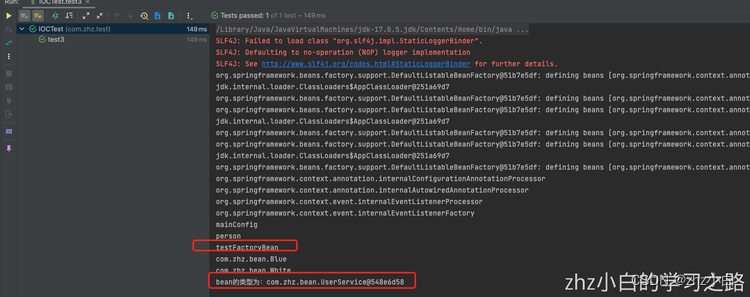
我们看一下运行结果:
总结:
- 我们在实际中虽然使用的是@Bean注解向容器中注册的是TestFactoryBean对象,但是确是调用的getObject()方法,对象类型是getObject的返回值
2.2.4、疑问:怎么获取FactoryBean对象本身?加&
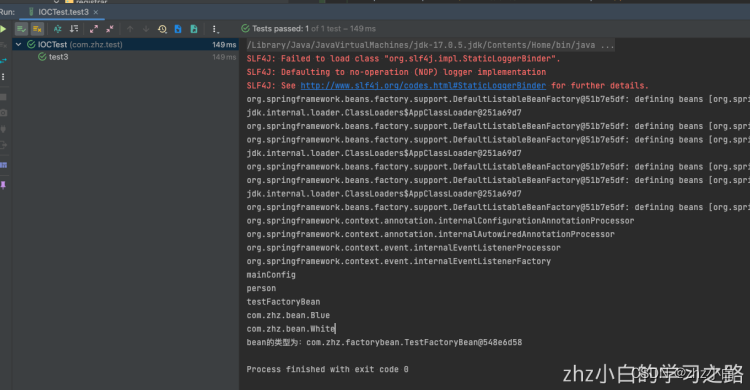
我么只需要在获取Bean的时候,加上&符号,那么他就会获取FactoryBean本身了,比如**&testFactoryBean**
@Testpublic void test3(){AnnotationConfigApplicationContext applicationContext = new AnnotationConfigApplicationContext(MainConfig.class);String[] beanDefinitionNames = applicationContext.getBeanDefinitionNames();for (String beanDefinitionName : beanDefinitionNames) {System.out.println(beanDefinitionName);}Object colorFactoryBean = applicationContext.getBean("&testFactoryBean");System.out.println("bean的类型为:"+colorFactoryBean);}
运行结果
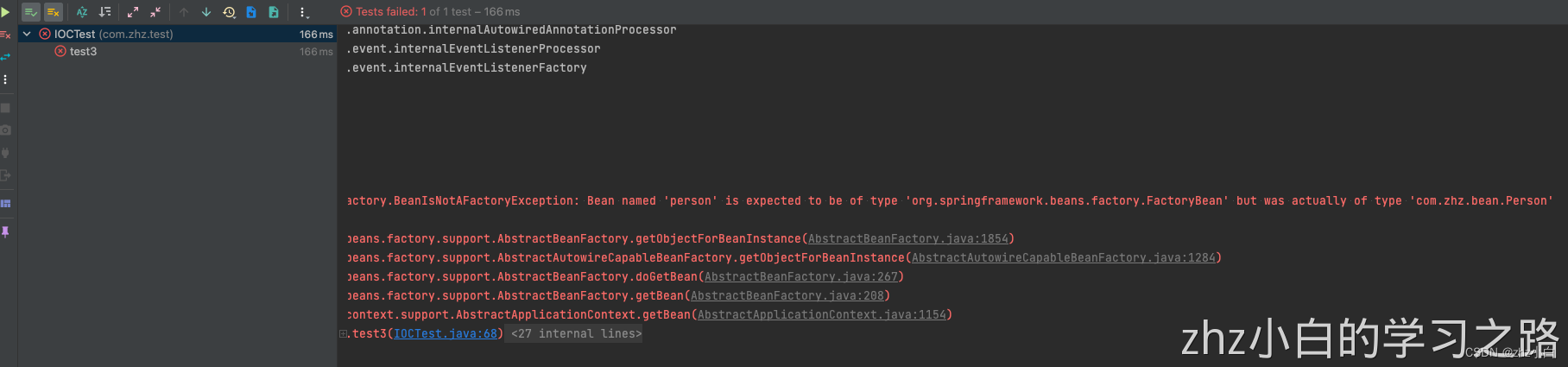
扩展:如果当前Bean不是FactoryBean的实现类,也加了&,那么会报错,具体样例如下:如下我们的person就是一个跟简单的Bean类
@Testpublic void test3(){AnnotationConfigApplicationContext applicationContext = new AnnotationConfigApplicationContext(MainConfig.class);String[] beanDefinitionNames = applicationContext.getBeanDefinitionNames();for (String beanDefinitionName : beanDefinitionNames) {System.out.println(beanDefinitionName);}Object colorFactoryBean = applicationContext.getBean("&testFactoryBean");Object person = applicationContext.getBean("&person");System.out.println("bean的类型为:"+colorFactoryBean);System.out.println("bean的类型为:"+person);}
运行结果为:
2.4.5、为什么加了&之后就能获取FactoryBean对象实例呢?
我们看其BeanFactory接口,源码如下:
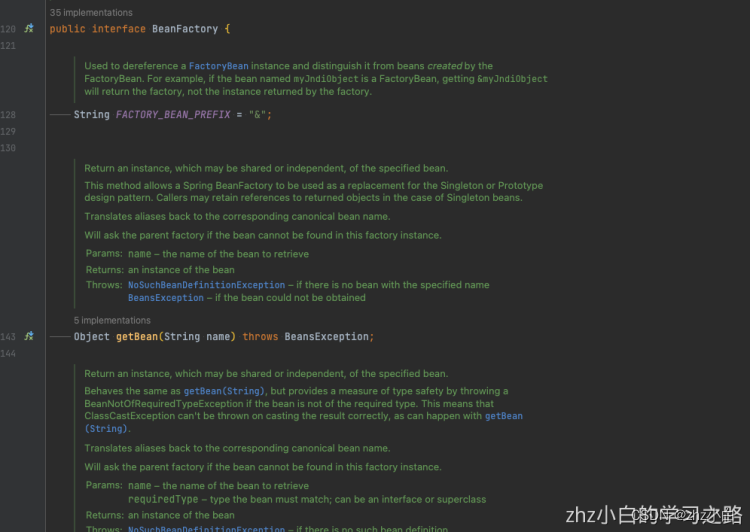
- 在BeanFactory接口中定义了一个**&**前缀,只要我们使用bean的id来从Spring容器中获取bean时,Spring就会知道我们是在获取FactoryBean本身。
上一篇:你的眼睛很清楚!你什么意思?
下一篇:搬到新家。如何写贺词