

Linux: network: tcp_rmem/rmem_default
文章目录
- tcp_rmem - 取值是:3个整数向量: min, default, max
- min
- default:
- max
- rmem_default
- rmem_max
- 具体的用法
- 相关的方法
tcp_rmem - 取值是:3个整数向量: min, default, max
min
TCP sockets使用的最小接收缓存大小。这个最小值的作用是在,内存处在轻微压力下时,也会给socket分配的内存大小。
Default: 4K
default:
TCP sockets 初始时分配的接收缓存大小。这个值会覆盖net.core.rmem_default这个值。 默认是:87380 bytes。这个值也是计算窗口的输入值,This value results in window of 65535 with default setting of tcp_adv_win_scale and tcp_app_win:0 and a bit less for default tcp_app_win. See below about these variables.
max
允许TCP socket自动选择接收缓存的最大值。不会覆盖net.core.rmem_max。调用setsockopt()设置SO_RCVBUF会将自动调整缓存大小的方法关闭,这样这个值就没有任何作用了。默认值,在87380字节到6M之间,具体值依赖于RAM的大小。
rmem_default
The default setting of the socket receive buffer in bytes.
rmem_max
The maximum receive socket buffer size in bytes.
具体的用法
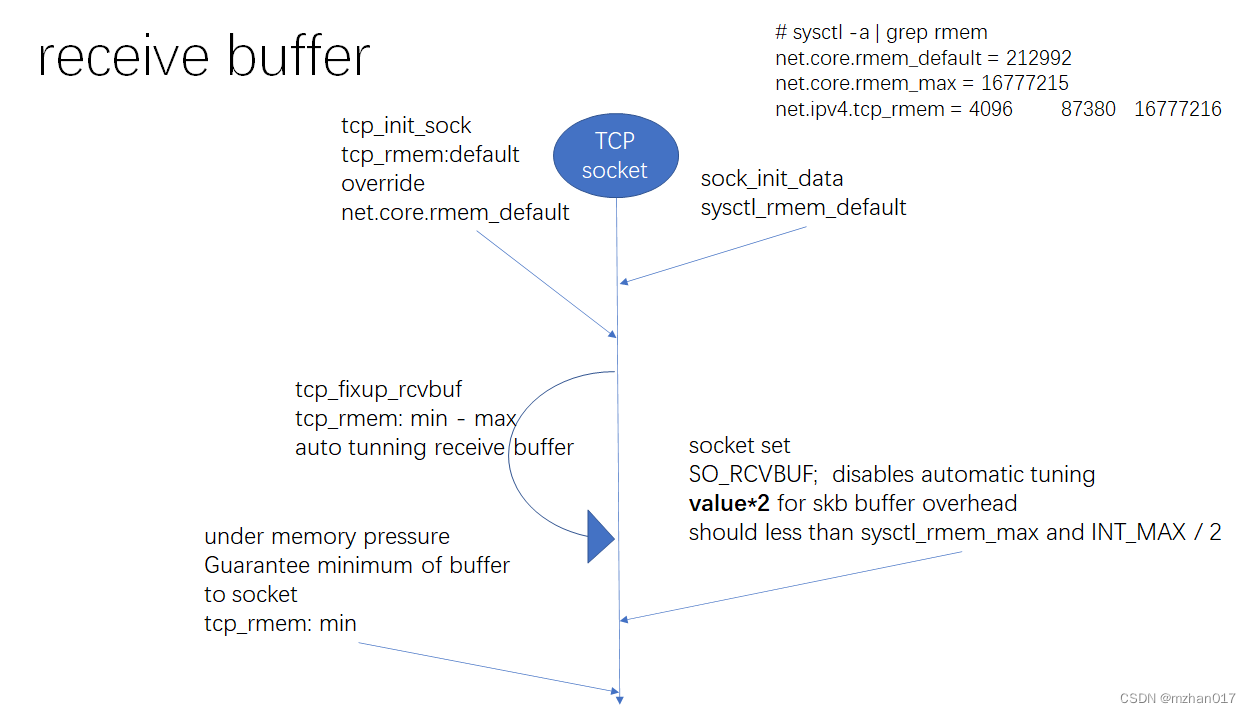
创建socket一开始的recv buff的大小是rmem_default;后续tcp层会重新设置这个receivebuffer到tcp_rmem:default;
然后,socket的用户标记为非SOCK_RCVBUF_LOCK;就会调用tcp_fixup_rcvbuf函数进行接收缓存大小的重新计算。
sk->sk_userlocks |= SOCK_RCVBUF_LOCK;
相关的方法
void sock_init_data(struct socket *sock, struct sock *sk)
{sk_init_common(sk);sk->sk_send_head	=	NULL;timer_setup(&sk->sk_timer, NULL, 0);sk->sk_allocation	=	GFP_KERNEL;sk->sk_rcvbuf		=	sysctl_rmem_default;{.procname	= "rmem_default",.data		= &sysctl_rmem_default,.maxlen		= sizeof(int),.mode		= 0644,.proc_handler	= proc_dointvec_minmax,.extra1		= &min_rcvbuf,
},/* 3. Tuning rcvbuf, when connection enters established state. */
static void tcp_fixup_rcvbuf(struct sock *sk)
{u32 mss = tcp_sk(sk)->advmss;int rcvmem;rcvmem = 2 * SKB_TRUESIZE(mss + MAX_TCP_HEADER) *tcp_default_init_rwnd(mss);/* Dynamic Right Sizing (DRS) has 2 to 3 RTT latency* Allow enough cushion so that sender is not limited by our window*/if (sock_net(sk)->ipv4.sysctl_tcp_moderate_rcvbuf)rcvmem <<= 2;if (sk->sk_rcvbuf < rcvmem)sk->sk_rcvbuf = min(rcvmem, sock_net(sk)->ipv4.sysctl_tcp_rmem[2]);
}case SO_RCVBUF:/* Don't error on this BSD doesn't and if you think* about it this is right. Otherwise apps have to* play 'guess the biggest size' games. RCVBUF/SNDBUF* are treated in BSD as hints*/val = min_t(u32, val, sysctl_rmem_max);
set_rcvbuf:/* Ensure val * 2 fits into an int, to prevent max_t()* from treating it as a negative value.*/val = min_t(int, val, INT_MAX / 2);sk->sk_userlocks |= SOCK_RCVBUF_LOCK;/** We double it on the way in to account for* "struct sk_buff" etc. overhead.   Applications* assume that the SO_RCVBUF setting they make will* allow that much actual data to be received on that* socket.** Applications are unaware that "struct sk_buff" and* other overheads allocate from the receive buffer* during socket buffer allocation.** And after considering the possible alternatives,* returning the value we actually used in getsockopt* is the most desirable behavior.*/sk->sk_rcvbuf = max_t(int, val * 2, SOCK_MIN_RCVBUF);