

Redis对象及redisObject源码解析
写在前面
以下内容是基于Redis 6.2.6 版本整理总结
一、对象
前面几篇文章,我们介绍了Redis用到的主要的数据结构,如:sds、list、dict、ziplist、skiplist、inset等。
但是,Redis并没有直接使用这些数据结构来实现key-value数据库,而是基于这些数据结构构建了一个对象系统。包括字符串对象、列表对象、哈希对象、集合对象和有序集合对象五种类型的对象。每种对象都使用了至少一种前面提到的数据结构。
通过对对象的区分,Redis可以在执行命令前判断该对象是否能够执行该条命令。为对象设置不同的数据结构实现,只要是为了提高效率。
二、对象的类型及编码
Redis使用对象来表示数据中的key和value,每当我们在Redis数据库中创建一个新的键值对时,至少会创建两个对象,一个作用域key,另一个作用于value。
举个栗子:set msg “hello world” 表示分别创建了一个字符串对象保存“msg”,另一个字符串对象保存“hello world”:

redisObject 结构体
Redis中的每个对象由 redisObject 结构体来描述,对象的类型、编码、内存回收、共享对象都需要redisObject的支持,redisObject 结构体定义如下:
#define LRU_BITS 24
typedef struct redisObject {unsigned type:4;   // 类型unsigned encoding:4; // 编码unsigned lru:LRU_BITS; /* LRU time (relative to global lru_clock) or* LFU data (least significant 8 bits frequency* and most significant 16 bits access time). */int refcount;void *ptr;
} robj;
下面我们来看看每个字段的含义:
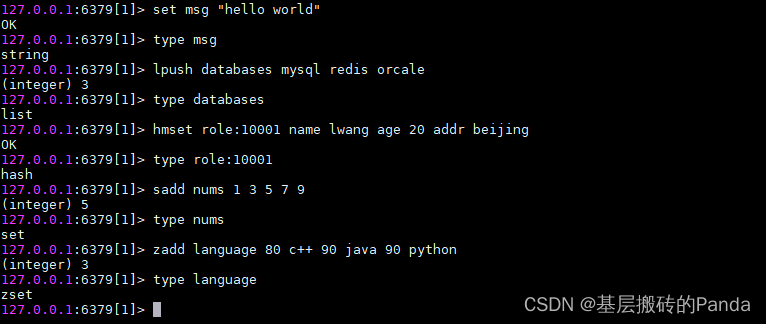
(1)type: 占4个比特位,表示对象的类型,有五种类型。当我们执行type命令时,便是通过type字段获取对象的类型。
/* The actual Redis Object */
#define OBJ_STRING 0    /* String object. */
#define OBJ_LIST 1      /* List object. */
#define OBJ_SET 2       /* Set object. */
#define OBJ_ZSET 3      /* Sorted set object. */
#define OBJ_HASH 4      /* Hash object. */
type命令使用示例:
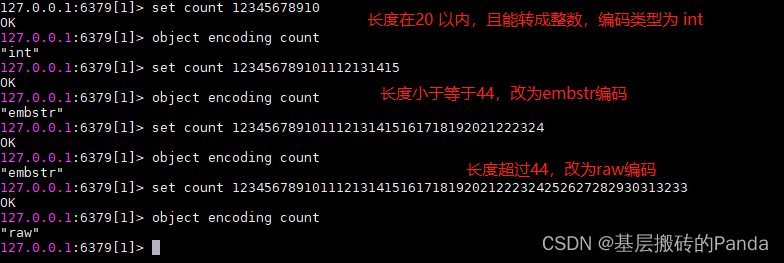
(2)encoding: 占4个比特位,表示对象使用哪种编码,redis会根据不同的场景使用不同的编码,大大提高了redis的灵活性和效率。
字符串对象不同编码类型示例:
(3)lru: 占 24 个比特位,记录该对象最后一次被访问的时间。千万别以为这只能在LRU淘汰策略中才用,LFU也是复用的个字段。当使用LRU时,它保存的上次读写的24位unix时间戳(秒级);使用LFU时,24位会被分为两个部分,16位的分钟级时间戳和8位特殊计数器,这里就不展开了,详细可以注意我后续的文章。
(4)refcount: 对象的引用计数,类似于shared_ptr 智能指针的引用计数,当refcount为0时,释放该对象。
(5)ptr: 指向对象具体的底层实现的数据结构。
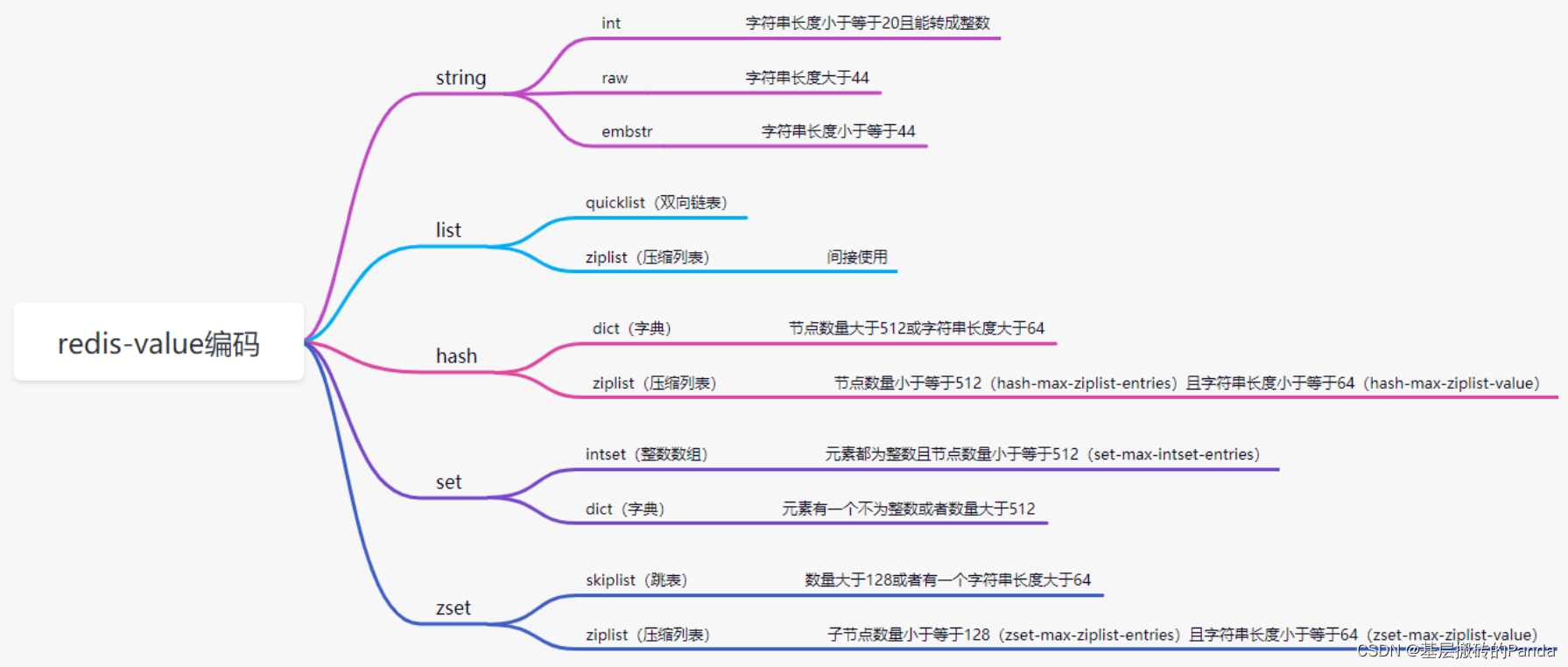
三、不同对象编码规则
四、对象在源码中的使用
4.1 字符串对象
4.1.1字符串对象创建
// code location: src/object.c
#define OBJ_ENCODING_EMBSTR_SIZE_LIMIT 44
// 创建 strintg 对象
robj *createStringObject(const char *ptr, size_t len) {// 如果待保存的字符串的长度小于等于44,使用 embstr 编码if (len <= OBJ_ENCODING_EMBSTR_SIZE_LIMIT)return createEmbeddedStringObject(ptr,len);else // 否则使用 raw 编码return createRawStringObject(ptr,len);
}robj *createEmbeddedStringObject(const char *ptr, size_t len) {// 申请 robj + sdshdr + data + 1 的空间robj *o = zmalloc(sizeof(robj)+sizeof(struct sdshdr8)+len+1);struct sdshdr8 *sh = (void*)(o+1);o->type = OBJ_STRING;      // 设置类型o->encoding = OBJ_ENCODING_EMBSTR; // 设置编码o->ptr = sh+1;o->refcount = 1;if (server.maxmemory_policy & MAXMEMORY_FLAG_LFU) {o->lru = (LFUGetTimeInMinutes()<<8) | LFU_INIT_VAL;} else {o->lru = LRU_CLOCK();}sh->len = len;sh->alloc = len;sh->flags = SDS_TYPE_8;if (ptr == SDS_NOINIT)sh->buf[len] = '\0';else if (ptr) {memcpy(sh->buf,ptr,len);sh->buf[len] = '\0';} else {memset(sh->buf,0,len+1);}return o;
}
从 createEmbeddedStringObject 函数可以看到,该对象是robj和sds的结合体,将sds直接放入到robj里,这也是嵌入式编码embstr的由来。
为什么要限制44字节呢?因为robj结构体占16个字节,sdshdr结构体占3个字节,最后结尾的‘\0’占一个字节,限制44个字节,就能保证64个字节里能放下所有内容(16+3+1+44 = 64)。
4.1.2 字符串对象编码
Redis将节省内存做到了极致,它的作者对字符串对象又做了特殊的编码处理,以进一步达到节省空间的目的。编码处理过程及代码注释如下:
/* Try to encode a string object in order to save space */
robj *tryObjectEncoding(robj *o) {long value;sds s = o->ptr;size_t len;/* Make sure this is a string object, the only type we encode* in this function. Other types use encoded memory efficient* representations but are handled by the commands implementing* the type. */// 这里只对string对象进行编码,其他类型的编码都有对应的具体实现处理serverAssertWithInfo(NULL,o,o->type == OBJ_STRING);/* We try some specialized encoding only for objects that are* RAW or EMBSTR encoded, in other words objects that are still* in represented by an actually array of chars. */// 非sds string对象,直接返回原对象if (!sdsEncodedObject(o)) return o;/* It's not safe to encode shared objects: shared objects can be shared* everywhere in the "object space" of Redis and may end in places where* they are not handled. We handle them only as values in the keyspace. */// 如果该对象由其他对象共享,不能编码,如果编码可能影响到其他对象的使用if (o->refcount > 1) return o;/* Check if we can represent this string as a long integer.* Note that we are sure that a string larger than 20 chars is not* representable as a 32 nor 64 bit integer. */// 检查能否把一个字符串表示为长整型数,长度要小于等于20len = sdslen(s);if (len <= 20 && string2l(s,len,&value)) {/* This object is encodable as a long. Try to use a shared object.* Note that we avoid using shared integers when maxmemory is used* because every object needs to have a private LRU field for the LRU* algorithm to work well. */// 如果可以被编码为long型,且编码后的值小于OBJ_SHARED_INTEGERS(10000),且未配// 置LRU替换淘汰策略, 就使用这个数的共享对象,相当于所有小于10000的数都是用的同一个robjif ((server.maxmemory == 0 ||!(server.maxmemory_policy & MAXMEMORY_FLAG_NO_SHARED_INTEGERS)) &&value >= 0 &&value < OBJ_SHARED_INTEGERS){decrRefCount(o);incrRefCount(shared.integers[value]);return shared.integers[value];} else {if (o->encoding == OBJ_ENCODING_RAW) {sdsfree(o->ptr);o->encoding = OBJ_ENCODING_INT;o->ptr = (void*) value;return o;} else if (o->encoding == OBJ_ENCODING_EMBSTR) {decrRefCount(o);return createStringObjectFromLongLongForValue(value);}}}// 不能转为long的字符串/* If the string is small and is still RAW encoded,* try the EMBSTR encoding which is more efficient.* In this representation the object and the SDS string are allocated* in the same chunk of memory to save space and cache misses. */// 如果字符串的长度太小,小于等于44if (len <= OBJ_ENCODING_EMBSTR_SIZE_LIMIT) {robj *emb;// 如果当前编码是embstr,直接返回原对象,否则转为embstr编码,返回if (o->encoding == OBJ_ENCODING_EMBSTR) return o;emb = createEmbeddedStringObject(s,sdslen(s));decrRefCount(o);return emb;}/* We can't encode the object...** Do the last try, and at least optimize the SDS string inside* the string object to require little space, in case there* is more than 10% of free space at the end of the SDS string.** We do that only for relatively large strings as this branch* is only entered if the length of the string is greater than* OBJ_ENCODING_EMBSTR_SIZE_LIMIT. */// 如果前面编码没有成功,这里做最后一步,当编码类型为raw,且它的sds可用空间超过10%,// 尝试释放调这部分内存trimStringObjectIfNeeded(o);/* Return the original object. */// 返回原对象return o;
}
4.1.3 字符串对象解码
有编码就有解码,实际上只需要那些可以转为整型类型的字符串传进行解码,解码代码及注释如下:
robj *getDecodedObject(robj *o) {robj *dec;// 如果编码是 embstr 和 raw ,只是把引用计数加一,然后返回原对象if (sdsEncodedObject(o)) {incrRefCount(o);return o;}// 如果编码是 int 进行解码,返回新的对象if (o->type == OBJ_STRING && o->encoding == OBJ_ENCODING_INT) {char buf[32];ll2string(buf,32,(long)o->ptr);dec = createStringObject(buf,strlen(buf));return dec;} else {serverPanic("Unknown encoding type");}
}
4.2 redis对象引用计数及自动清理
void incrRefCount(robj *o) {if (o->refcount < OBJ_FIRST_SPECIAL_REFCOUNT) {o->refcount++; // 引用计数加一} else {if (o->refcount == OBJ_SHARED_REFCOUNT) {/* Nothing to do: this refcount is immutable. */} else if (o->refcount == OBJ_STATIC_REFCOUNT) {serverPanic("You tried to retain an object allocated in the stack");}}
}// 减少引用计数
void decrRefCount(robj *o) {// 释放空间if (o->refcount == 1) {switch(o->type) {case OBJ_STRING: freeStringObject(o); break;case OBJ_LIST: freeListObject(o); break;case OBJ_SET: freeSetObject(o); break;case OBJ_ZSET: freeZsetObject(o); break;case OBJ_HASH: freeHashObject(o); break;case OBJ_MODULE: freeModuleObject(o); break;case OBJ_STREAM: freeStreamObject(o); break;default: serverPanic("Unknown object type"); break;}zfree(o);} else {if (o->refcount <= 0) serverPanic("decrRefCount against refcount <= 0");if (o->refcount != OBJ_SHARED_REFCOUNT) o->refcount--; // 计数减一}
}
五、总结
- redis对象为所有类型的value提供了统一的封装
- 为对象的淘汰策略保存相关信息
- 实现引用计数及内存自动释放功能
上一篇:Vuex3使用教程(待续)
下一篇:描写蓝的四字词语