

分析linux启动内核源码
内核的启动时从main.c这个文件里面的start_kernel函数开始的,这个文件在linux源码里面的init文件夹下面
下面我们来看看这个函数 这个函数很长,可以看个大概过去
asmlinkage __visible void __init start_kernel(void)
{char *command_line;char *after_dashes;set_task_stack_end_magic(&init_task);smp_setup_processor_id();debug_objects_early_init();cgroup_init_early();local_irq_disable();early_boot_irqs_disabled = true;/** Interrupts are still disabled. Do necessary setups, then* enable them.*/boot_cpu_init();page_address_init();pr_notice("%s", linux_banner);setup_arch(&command_line);/** Set up the the initial canary and entropy after arch* and after adding latent and command line entropy.*/add_latent_entropy();add_device_randomness(command_line, strlen(command_line));boot_init_stack_canary();mm_init_cpumask(&init_mm);setup_command_line(command_line);setup_nr_cpu_ids();setup_per_cpu_areas();smp_prepare_boot_cpu();    /* arch-specific boot-cpu hooks */boot_cpu_hotplug_init();build_all_zonelists(NULL);page_alloc_init();pr_notice("Kernel command line: %s\n", boot_command_line);parse_early_param();after_dashes = parse_args("Booting kernel",static_command_line, __start___param,__stop___param - __start___param,-1, -1, NULL, &unknown_bootoption);if (!IS_ERR_OR_NULL(after_dashes))parse_args("Setting init args", after_dashes, NULL, 0, -1, -1,NULL, set_init_arg);jump_label_init();/** These use large bootmem allocations and must precede* kmem_cache_init()*/setup_log_buf(0);vfs_caches_init_early();sort_main_extable();trap_init();mm_init();ftrace_init();/* trace_printk can be enabled here */early_trace_init();/** Set up the scheduler prior starting any interrupts (such as the* timer interrupt). Full topology setup happens at smp_init()* time - but meanwhile we still have a functioning scheduler.*/sched_init();/** Disable preemption - early bootup scheduling is extremely* fragile until we cpu_idle() for the first time.*/preempt_disable();if (WARN(!irqs_disabled(),"Interrupts were enabled *very* early, fixing it\n"))local_irq_disable();radix_tree_init();/** Set up housekeeping before setting up workqueues to allow the unbound* workqueue to take non-housekeeping into account.*/housekeeping_init();/** Allow workqueue creation and work item queueing/cancelling* early.  Work item execution depends on kthreads and starts after* workqueue_init().*/workqueue_init_early();rcu_init();/* Trace events are available after this */trace_init();if (initcall_debug)initcall_debug_enable();context_tracking_init();/* init some links before init_ISA_irqs() */early_irq_init();init_IRQ();tick_init();rcu_init_nohz();init_timers();hrtimers_init();softirq_init();timekeeping_init();time_init();printk_safe_init();perf_event_init();profile_init();call_function_init();WARN(!irqs_disabled(), "Interrupts were enabled early\n");early_boot_irqs_disabled = false;local_irq_enable();kmem_cache_init_late();/** HACK ALERT! This is early. We're enabling the console before* we've done PCI setups etc, and console_init() must be aware of* this. But we do want output early, in case something goes wrong.*/console_init();if (panic_later)panic("Too many boot %s vars at `%s'", panic_later,panic_param);lockdep_init();/** Need to run this when irqs are enabled, because it wants* to self-test [hard/soft]-irqs on/off lock inversion bugs* too:*/locking_selftest();/** This needs to be called before any devices perform DMA* operations that might use the SWIOTLB bounce buffers. It will* mark the bounce buffers as decrypted so that their usage will* not cause "plain-text" data to be decrypted when accessed.*/mem_encrypt_init();#ifdef CONFIG_BLK_DEV_INITRDif (initrd_start && !initrd_below_start_ok &&page_to_pfn(virt_to_page((void *)initrd_start)) < min_low_pfn) {pr_crit("initrd overwritten (0x%08lx < 0x%08lx) - disabling it.\n",page_to_pfn(virt_to_page((void *)initrd_start)),min_low_pfn);initrd_start = 0;}
#endifkmemleak_init();setup_per_cpu_pageset();numa_policy_init();acpi_early_init();if (late_time_init)late_time_init();sched_clock_init();calibrate_delay();pid_idr_init();anon_vma_init();
#ifdef CONFIG_X86if (efi_enabled(EFI_RUNTIME_SERVICES))efi_enter_virtual_mode();
#endifthread_stack_cache_init();cred_init();fork_init();proc_caches_init();uts_ns_init();buffer_init();key_init();security_init();dbg_late_init();vfs_caches_init();pagecache_init();signals_init();seq_file_init();proc_root_init();nsfs_init();cpuset_init();cgroup_init();taskstats_init_early();delayacct_init();check_bugs();acpi_subsystem_init();arch_post_acpi_subsys_init();sfi_init_late();/* Do the rest non-__init'ed, we're now alive */arch_call_rest_init();
}【文章福利】小编推荐自己的Linux内核技术交流群:【977878001】整理一些个人觉得比较好得学习书籍、视频资料共享在群文件里面,有需要的可以自行添加哦!!!前100进群领取,额外赠送一份价值699的内核资料包(含视频教程、电子书、实战项目及代码)
内核资料直通车:Linux内核源码技术学习路线+视频教程代码资料
学习直通车:Linux内核源码/内存调优/文件系统/进程管理/设备驱动/网络协议栈
这个函数里面我们会看到有很多的各种init,也就是初始化,我们只说几个重点操作
首先来看下这个函数set_task_stack_end_magic(&init_task);
在linux里面所有的进程都是由父进程创建而来,所以说在启动内核的时候需要有个祖先进程,这个进程是系统创建的
第一个进程,我们称为0号进程,它是唯一一个没有通过fork或者kernel_thread的进程
然后就是初始化系统调用,对应的函数就是trap_init();这里面设置了很多中断门,用于处理各种中断
系统调用也是通过发送中断的方式进行的。
接下来就是内存管理模块的初始化,对应的函数是mm_init();
然后就是初始化任务调度,对应的函数就是sched_init();
这个任务调度是干嘛用的呢?就是操作系统协调进程和cpu,比如说分配哪个进程在cpu上运行呀,
在比如说你这个进程在cpu上运行时间过长了,然后操作系统就会把你踢下去,换另一个进程在cpu上运行。
到了这个preempt_disable();函数,这个函数的意思就是在这个函数运行以后就禁止被中断
也就是说在这个函数运行后面,如果没有主动让出cpu,那么其他进程是无法抢占他的。
然后看下这个tick_init();这个函数是时钟初始化,这个时钟的概念是什么意思呢?
计算机会每隔一段时间周期通知操作系统,就像时钟一样,滴答滴答,每滴答一下就是一个时间周期过去了,
通知操作系统后,操作系统会看下当前在cpu上运行的进程运行时间是否过长,如果过长就标识该进程为可抢占
然后在某些时机下会切掉该进程,换下一个进程。
最后start_kernel()调用的是rest_init()用来初始化其他方面,这里面做了好多事情
noinline void __ref rest_init(void)
{struct task_struct *tsk;int pid;rcu_scheduler_starting();/** We need to spawn init first so that it obtains pid 1, however* the init task will end up wanting to create kthreads, which, if* we schedule it before we create kthreadd, will OOPS.*/pid = kernel_thread(kernel_init, NULL, CLONE_FS);/** Pin init on the boot CPU. Task migration is not properly working* until sched_init_smp() has been run. It will set the allowed* CPUs for init to the non isolated CPUs.*/rcu_read_lock();tsk = find_task_by_pid_ns(pid, &init_pid_ns);set_cpus_allowed_ptr(tsk, cpumask_of(smp_processor_id()));rcu_read_unlock();numa_default_policy();pid = kernel_thread(kthreadd, NULL, CLONE_FS | CLONE_FILES);rcu_read_lock();kthreadd_task = find_task_by_pid_ns(pid, &init_pid_ns);rcu_read_unlock();/** Enable might_sleep() and smp_processor_id() checks.* They cannot be enabled earlier because with CONFIG_PREEMPT=y* kernel_thread() would trigger might_sleep() splats. With* CONFIG_PREEMPT_VOLUNTARY=y the init task might have scheduled* already, but it's stuck on the kthreadd_done completion.*/system_state = SYSTEM_SCHEDULING;complete(&kthreadd_done);/** The boot idle thread must execute schedule()* at least once to get things moving:*/schedule_preempt_disabled();/* Call into cpu_idle with preempt disabled */cpu_startup_entry(CPUHP_ONLINE);
}
首先调用kernel_thread()函数,用来创建用户态的第一个进程,这个进程是所有用户态进程的祖先进程,我们称为1号进程
这个一号进程进入用户态以后,开枝散叶,创建了很多子进程,子进程又创建子进程,就形成了一颗进程树。
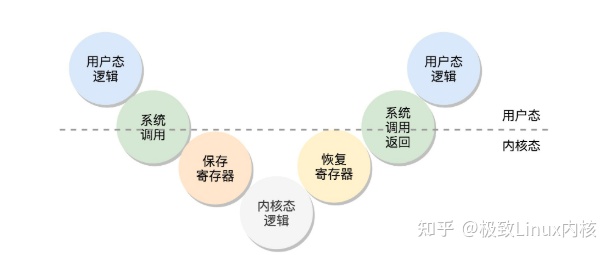
一旦有了用户进程,就需要划分资源了,比如说用户态的进程要想使用网卡发送数据,这个时候不能直接让用户态进程调用网卡
而是通过操作系统提供的系统调用函数,给进程发送数据,发送成功以后在返回到用户态进程,通知进程处理结果,也就是封装了
底层实现,用户态进程想要实现什么功能,直接调用系统调用就可以了,在用户态进程进行系统调用时,操作系统会把当前该进程的
参数都保存到寄存器里面,如果有对寄存器不懂的,就把寄存器想象成变量,变量是编程语言存放数据的,那么寄存器就是cpu用来存放数据的东西,
等到系统调用从内核态返回到用户态的时候,会恢复当时保存的寄存器里面的数据,继续运行。
这个过程就是这样的,用户态-》系统调用-》保存寄存器-》内核态执行系统调用-》恢复寄存器-》返回用户态 接着运行
然后接着说这个一号进程启动过程,现在这个进程还是在内核态的,那么要怎么把它搞到用户态里面的,
一般都是从用户态到内核态在返回到用户态,很少见过直接从内核态开始然后到用户态的
看下下面这个代码
void
start_thread(struct pt_regs *regs, unsigned long new_ip, unsigned long new_sp)
{
set_user_gs(regs, 0);
regs->fs    = 0;
regs->ds    = __USER_DS;
regs->es    = __USER_DS;
regs->ss    = __USER_DS;
regs->cs    = __USER_CS;
regs->ip    = new_ip;
regs->sp    = new_sp;
regs->flags    = X86_EFLAGS_IF;
force_iret();
}
EXPORT_SYMBOL_GPL(start_thread);
创建进程的这函数最后会有这么一个函数也就是start_thread(),这里面把各个寄存器都设置为了_USER,啥意思呢,里面将用户态的代码段CS设置为_USER_CS,将用户态的数据段DS设置为_USER_DS,
以及指令指针寄存器IP,栈顶指针SP,最后的force_iret();是用来恢复寄存器的,按理来说应该恢复在系统调用的时候保存的寄存器,这里面恢复的其实就是上面设置的寄存器。CS和指令指针寄存器IP恢复了,
指向用户态下一个要执行的语句,DS和函数栈指针SP也被恢复了,指向用户态函数栈的栈顶,所以,下一条指令就从用户态开始了。
用户态的祖先进程创建完了,那么内核态有没有一个祖先进程呢?
有的,rest_init第二大事情就是第三个进程,也就是2号进程。
上一篇:描写皮影戏的句子