

Transformer Fusion for Indoor RGB-D Semantic Segmentation非官方自己实现的代码
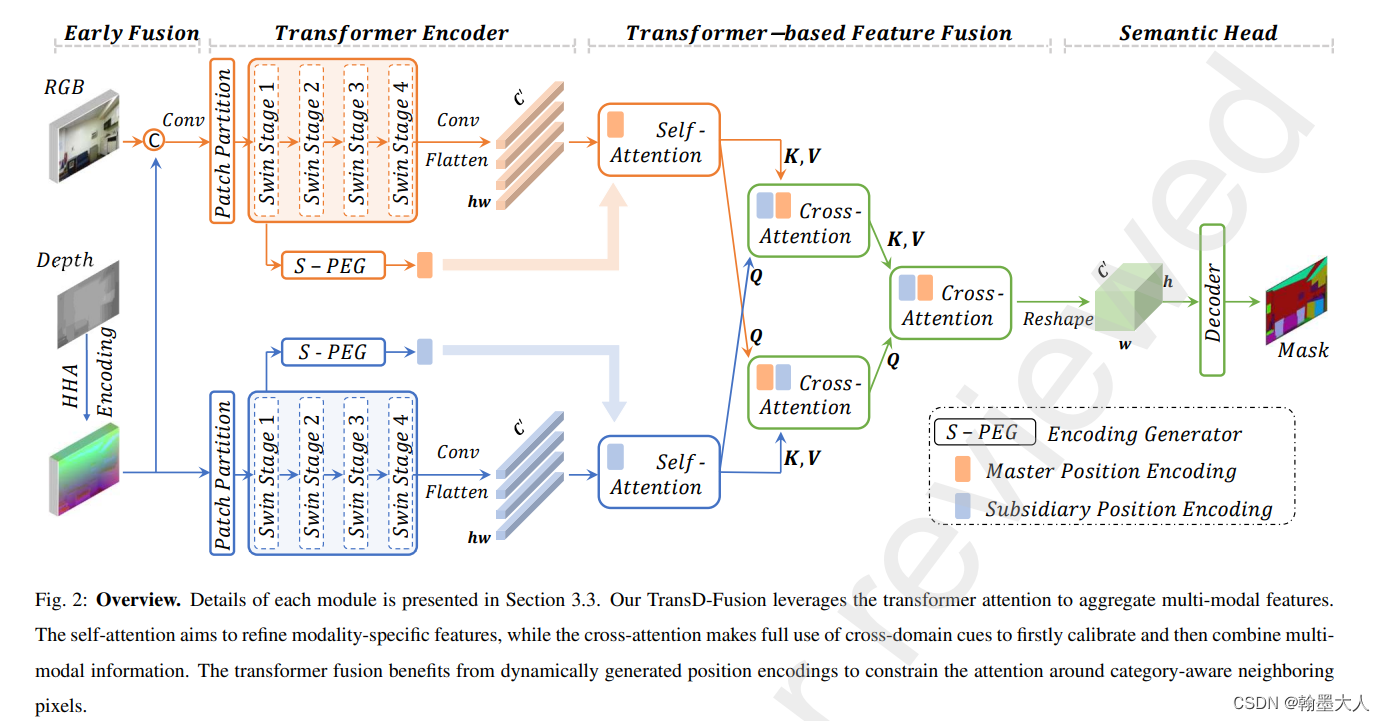
声明:文章没有官方的代码,这里自己浅显的分析一下。
首先看一下encoder,就是swin transformer,假设RGB的维度为(1,3,480,480),Depth维度为(1,1,480,480)。维度分别变为**(1,64,120,120)—>(1,64,120,120)—>(1,128,60,60)—>(1,256,30,30)—>(1,512,15,15)。**
接着经过卷积,然后展平。在原文中,通道进行了减少,假设我们这里通过一个1x1卷积,将通道由512缩减到256.然后进行展平,(1,256,15,15)展平为(1,256,225)。
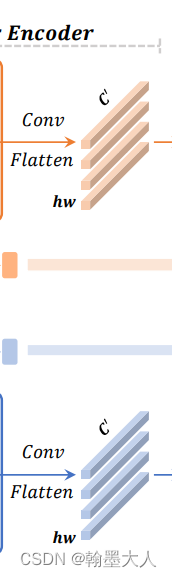
接着输入到三步融合模块中。
首先大小和维度经过融合后是不发生变换的。即输出也为(1,256,225)。
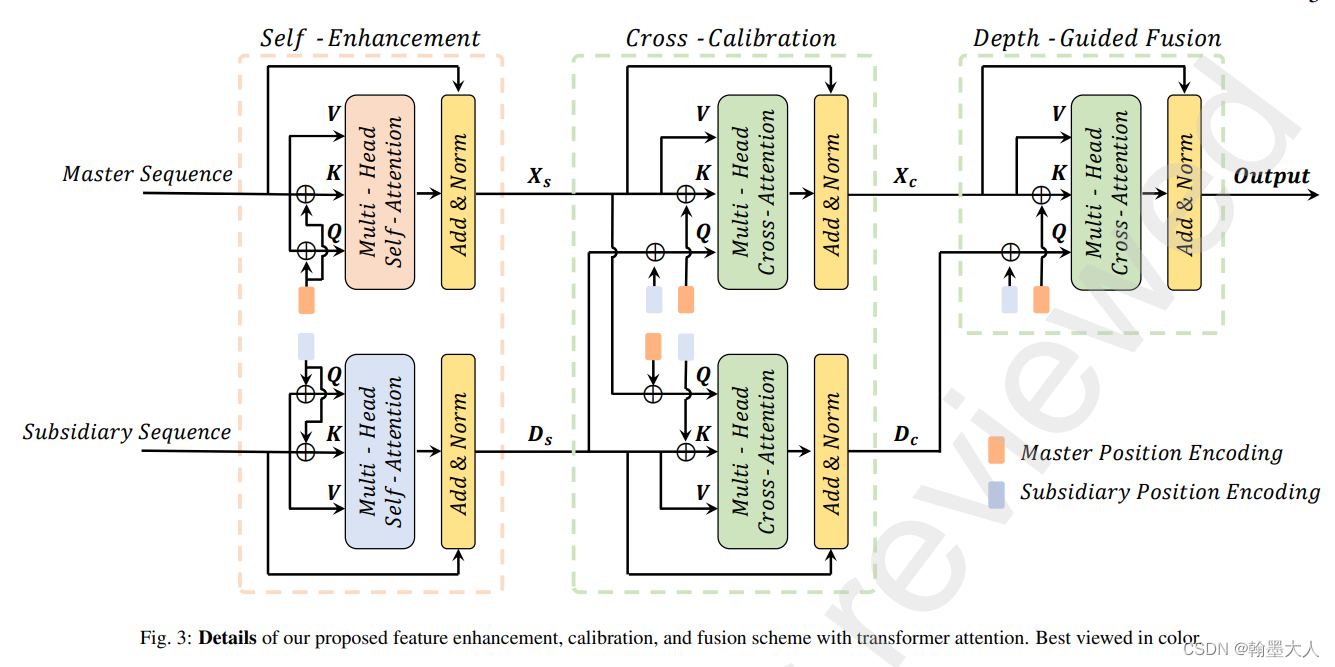
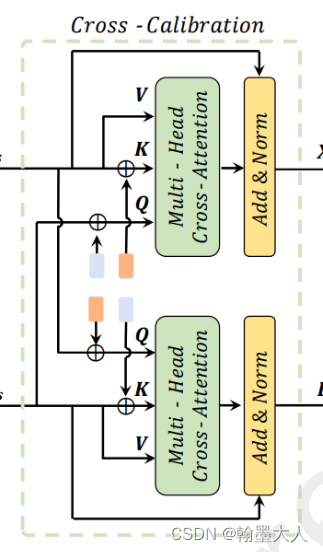
然后就是图中的位置编码:
既然他能和K和Q进行相加,那么维度肯定是匹配的。
公式:我们可以看到位置编码是在生成Q,K,V之后才加上的。而非先加上再生成Q,K,V因为V就没有加位置编码。且这个地方采用的多头,对每一个头的Q和V进行相加。
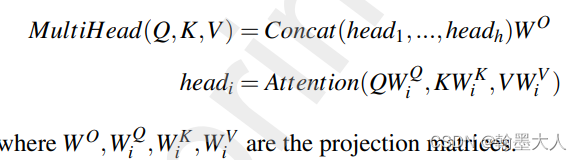

把公式5括号里面的参数带入到multihead(Q,K,V)中。
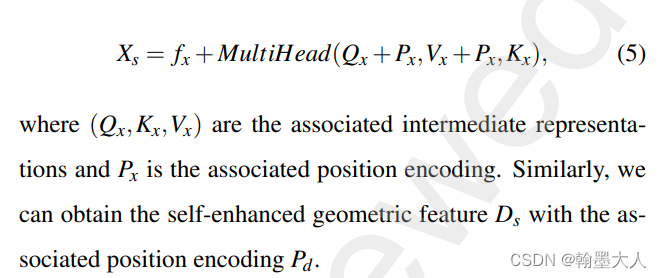
关于这个地方位置编码的相加存在一些疑问:
首先他的计算方式和VIT的一样,没有什么不同,但是关键在于只对Q和K进行相加,对V没有加。
我们看VIT的维度变化,VIT使用了多头注意力计算。本来每个头的Q,K,V都计算一次,即每次只有一个头,有多少个头计算多少次,然后总的结果按照维度进行拼接。
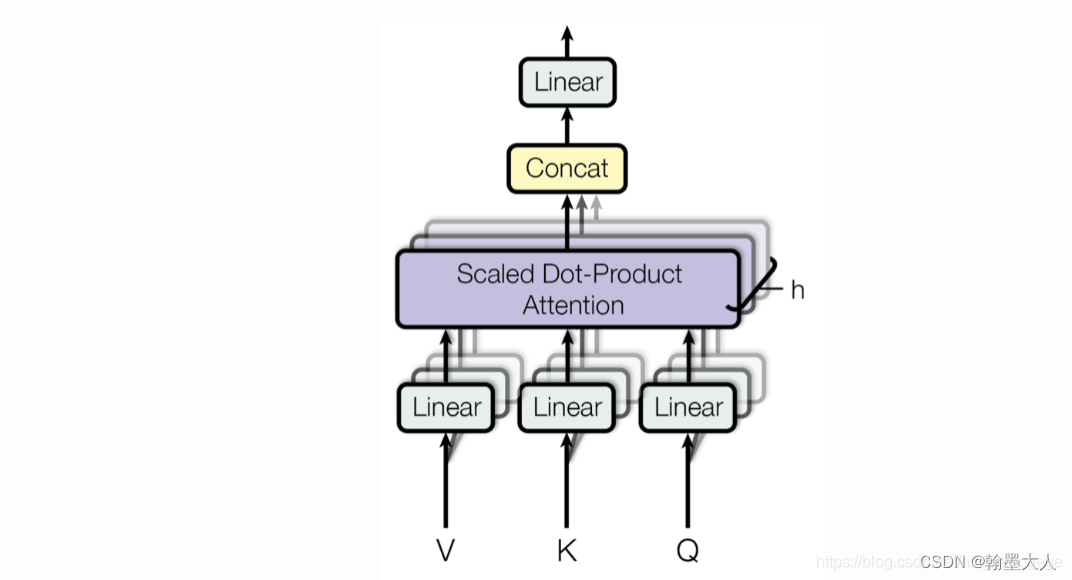
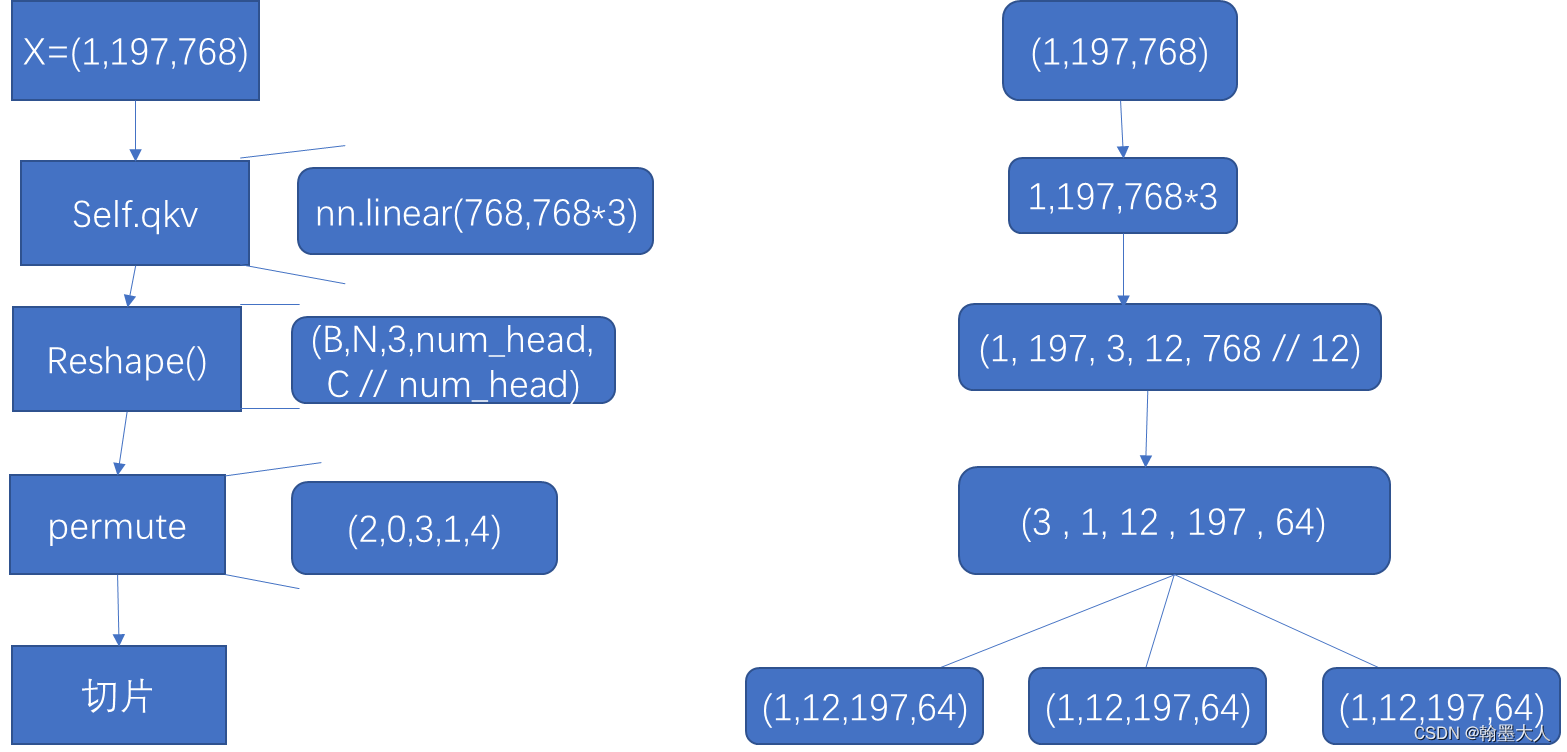
在代码中(12个头),实现的是Q,K,V有12个头,Q,K,V总共只计算一次。
在本文中,位置编码为第一个stage的输出,即(1,14400,64)。经过reshape为图片(1,64,120,120)。我们知道self.attention的输入为(1,225,256)。那么如果要相加,需要把维度升高到256,即原文中的投影到高维空间(语义信息就更丰富)。然后经过两个3x3卷积进行局部特征提取,最后进行下采样,reshape到序列。
我们猜测一下(1,64,120,120)—>(1,256,120,120)—>(1,256,120,120)—>(1,256,120,120)—>(1,256,15,15)—>(1,225,256)
然后回到融合部分,输入master序列为(1,225,256),经过类似VIT线性投影操作,生成Q,K,V,和VIT一样是多头,那么假设有8个头,那么Q,K,V的维度分别为(1,8,225,32)。然后就是位置编码(1,225,256)经过reshape,即分为八个头,每个头维度为(1,225,32)。这样就可以和Q,V进行相加。至于为什么V不加位置编码,我也不晓得。难道是为了和后面保持一致?补充序列也一样。
后面的交叉注意力:和前面的基本一样,区别是:上下两个分支的Q和Q带的位置编码分别来自对方。因为他们两个分支的头一样,维度一样,只有模态不一样,所以进行相乘还是不难的,还有就是位置编码和前一个自注意力使用的是一样的,即一个来自stage1的位置编码全程使用。
最后是深度引导,上一个模块的辅助分支的输出(1,225,256),仍然经过线性投影为多头。他进行qkv生成时候的linear就不需要x3了,,因为他只有一个输出。同理主分支也只需生成两个分支,embed_dim扩大两倍。最后在reshape为图片大小,即(1,256,15,15)。
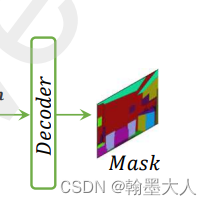
decoder:八倍上采样。
自己写的代码,很粗糙,其中将swin transformer转换为了resnet34,这样结构简单了点,而且每一层的输出都是图片,避免了位置编码还要将序列转换为图片。都是一些很简单的函数,如有错误,欢迎指正。
import warningsimport numpy as np
import torch
import torch.nn as nn
import torch.nn.functional as F
from torchsummary import summary
# from src.models.refine import Refine
from src.models.resnet import ResNet34
from src.models.context_modules import get_context_module
from src.models.resnet import BasicBlock, NonBottleneck1D# from src.models.model_utils import ConvBNAct, Swish, Hswish
# conding=gb2312def convt_bn_relu(ch_in, ch_out, kernel=3, stride=2, padding=1, output_padding=1,bn=True, relu=True):assert (kernel % 2) == 1, \'only odd kernel is supported but kernel = {}'.format(kernel)layers = []layers.append(nn.ConvTranspose2d(ch_in, ch_out, kernel, stride, padding,output_padding, bias=not bn))if bn:layers.append(nn.BatchNorm2d(ch_out))if relu:layers.append(nn.ReLU(inplace=True))layers = nn.Sequential(*layers)return layersdef conv_bn_relu(ch_in, ch_out, kernel, stride=1, padding=0, bn=True,relu=True):assert (kernel % 2) == 1, \'only odd kernel is supported but kernel = {}'.format(kernel)layers = []layers.append(nn.Conv2d(ch_in, ch_out, kernel, stride, padding,bias=not bn))if bn:layers.append(nn.BatchNorm2d(ch_out))if relu:layers.append(nn.ReLU(inplace=True))layers = nn.Sequential(*layers)return layersdef drop_path(x, drop_prob: float = 0., training: bool = False):if drop_prob == 0. or not training:return xkeep_prob = 1 - drop_probshape = (x.shape[0],) + (1,) * (x.ndim - 1)  # work with diff dim tensors, not just 2D ConvNetsrandom_tensor = keep_prob + torch.rand(shape, dtype=x.dtype, device=x.device)random_tensor.floor_()  # binarizeoutput = x.div(keep_prob) * random_tensorreturn outputclass DropPath(nn.Module):def __init__(self, drop_prob=None):super(DropPath, self).__init__()self.drop_prob = drop_probdef forward(self, x):return drop_path(x, self.drop_prob, self.training)class Mlp(nn.Module):"""MLP as used in Vision Transformer, MLP-Mixer and related networks"""def __init__(self, in_features, hidden_features=None, out_features=None, act_layer=nn.GELU, drop=0.):super().__init__()out_features = out_features or in_featureshidden_features = hidden_features or in_featuresself.fc1 = nn.Linear(in_features, hidden_features)self.act = act_layer()self.fc2 = nn.Linear(hidden_features, out_features)self.drop = nn.Dropout(drop)def forward(self, x):x = self.fc1(x)x = self.act(x)x = self.drop(x)x = self.fc2(x)x = self.drop(x)return xclass Spge(nn.Module):def __init__(self,in_channels,):super(Spge, self).__init__()self.spge_rgb = nn.Sequential(nn.Conv2d(in_channels, in_channels * 4, kernel_size=1, stride=1, padding=0),conv_bn_relu(in_channels * 4, in_channels * 4, kernel=3, padding=1, bn=True, relu=True),conv_bn_relu(in_channels * 4, in_channels * 4, kernel=3, padding=1, bn=True, relu=True))self.spge_depth = nn.Sequential(nn.Conv2d(in_channels, in_channels * 4, kernel_size=1, stride=1, padding=0),conv_bn_relu(in_channels * 4, in_channels * 4, kernel=3, padding=1, bn=True, relu=True),conv_bn_relu(in_channels * 4, in_channels * 4, kernel=3, padding=1, bn=True, relu=True))def forward(self,rgb,depth): #(1,64,120,120)_,_,h,w = rgb.size()rgb_f = self.spge_rgb(rgb)#(1,256,120,120)depth_f = self.spge_depth(depth)#(1,256,120,120)rgb_f_1 = F.interpolate(rgb_f,size=(h//8,w//8),mode='nearest').flatten(2).permute(0,2,1)#(1,256,15,15)depth_f_1 = F.interpolate(depth_f,size=(h//8,w//8),mode='nearest').flatten(2).permute(0,2,1)#(1,256,15,15)return rgb_f_1 ,depth_f_1class Attention(nn.Module):def __init__(self,dim,   # 输入token的dimnum_heads=8,qkv_bias=False,qk_scale=None,attn_drop_ratio=0.,proj_drop_ratio=0.):super(Attention, self).__init__()self.num_heads = num_headshead_dim = dim // num_headsself.scale = qk_scale or head_dim ** -0.5self.qkv = nn.Linear(dim, dim * 3, bias=qkv_bias)self.pos = nn.Linear(dim, dim, bias=qkv_bias)self.attn_drop = nn.Dropout(attn_drop_ratio)self.proj = nn.Linear(dim, dim)self.proj_drop = nn.Dropout(proj_drop_ratio)def forward(self, x ,pe):# [batch_size, num_patches + 1, total_embed_dim]B, N, C = x.shape #(1,225,256)b, n, c = pe.shape#(1,225,256)posenc = self.pos(pe).reshape(b, n, self.num_heads, c // self.num_heads).permute(0,2,1,3)#(1,8,225,32)# qkv(): -> [batch_size, num_patches + 1, 3 * total_embed_dim]# reshape: -> [batch_size, num_patches + 1, 3, num_heads, embed_dim_per_head]# permute: -> [3, batch_size, num_heads, num_patches + 1, embed_dim_per_head]qkv = self.qkv(x).reshape(B, N, 3, self.num_heads, C // self.num_heads).permute(2, 0, 3, 1, 4)#(3,1,8,225,32)# [batch_size, num_heads, num_patches + 1, embed_dim_per_head]# q, k, v = qkv[0], qkv[1], qkv[2]  # make torchscript happy (cannot use tensor as tuple)q = qkv[0] + posenc #(1,8,225,32)k = qkv[1] + posenc #(1,8,225,32)v = qkv[2]          #(1,8,225,32)# transpose: -> [batch_size, num_heads, embed_dim_per_head, num_patches + 1]# @: multiply -> [batch_size, num_heads, num_patches + 1, num_patches + 1]attn = (q @ k.transpose(-2, -1)) * self.scale#(1,8,225,225)attn = attn.softmax(dim=-1)attn = self.attn_drop(attn)# @: multiply -> [batch_size, num_heads, num_patches + 1, embed_dim_per_head]# transpose: -> [batch_size, num_patches + 1, num_heads, embed_dim_per_head]# reshape: -> [batch_size, num_patches + 1, total_embed_dim]x = (attn @ v).transpose(1, 2).reshape(B, N, C) #(1,225,256)x = self.proj(x)x = self.proj_drop(x)return xclass Attention_c(nn.Module):def __init__(self,dim,   # 输入token的dimnum_heads=8,qkv_bias=False,qk_scale=None,attn_drop_ratio=0.,proj_drop_ratio=0.):super(Attention_c, self).__init__()self.num_heads = num_headshead_dim = dim // num_headsself.scale = qk_scale or head_dim ** -0.5self.qkv = nn.Linear(dim, dim * 3, bias=qkv_bias)self.pos = nn.Linear(dim, dim, bias=qkv_bias)self.attn_drop = nn.Dropout(attn_drop_ratio)self.proj = nn.Linear(dim, dim)self.proj_drop = nn.Dropout(proj_drop_ratio)def forward(self, x ,y, x_pos, y_pos): #(depth_s,rgb_s,depth_pe,rgb_pe)B, N, C = x.shape #(1,225,256)b, n, c = x_pos.shape#(1,225,256)x_pos = self.pos(x_pos).reshape(b, n,self.num_heads, c // self.num_heads).permute(0,2,1,3)#(1,8,225,32)y_pos = self.pos(y_pos).reshape(b, n,self.num_heads, c // self.num_heads).permute(0,2,1,3)#(1,8,225,32)qkv_x = self.qkv(x).reshape(B, N, 3, self.num_heads, C // self.num_heads).permute(2, 0, 3, 1, 4)#(3,1,8,225,32)qkv_y = self.qkv(y).reshape(B, N, 3, self.num_heads, C // self.num_heads).permute(2, 0, 3, 1, 4)#(3,1,8,225,32)q = qkv_y[0] + y_pos #(1,8,225,32)k = qkv_x[1] + x_pos #(1,8,225,32)v = qkv_x[2]#(1,8,225,32)attn = (q @ k.transpose(-2, -1)) * self.scaleattn = attn.softmax(dim=-1)attn = self.attn_drop(attn)x = (attn @ v).transpose(1, 2).reshape(B, N, C)x = self.proj(x)x = self.proj_drop(x)return xclass Attention_g(nn.Module):def __init__(self,dim,   # 输入token的dimnum_heads=8,qkv_bias=False,qk_scale=None,attn_drop_ratio=0.,proj_drop_ratio=0.):super(Attention_g, self).__init__()self.num_heads = num_headshead_dim = dim // num_headsself.scale = qk_scale or head_dim ** -0.5self.qkv_x = nn.Linear(dim, dim * 3, bias=qkv_bias)self.qkv_y = nn.Linear(dim, dim,bias=qkv_bias)self.pos = nn.Linear(dim, dim * 3, bias=qkv_bias)self.attn_drop = nn.Dropout(attn_drop_ratio)self.proj = nn.Linear(dim, dim)self.proj_drop = nn.Dropout(proj_drop_ratio)def forward(self, x ,y, x_pos, y_pos):B, N, C = x.shape #(1,225,256)b, n, c = x_pos.shapex_pos = self.pos(x_pos).reshape(b, n, 3, self.num_heads, c // self.num_heads).permute(2, 0, 3, 1, 4)y_pos = self.pos(y_pos).reshape(b, n, 3, self.num_heads, c // self.num_heads).permute(2, 0, 3, 1, 4)qkv_x = self.qkv_x(x).reshape(B, N, 3, self.num_heads, C // self.num_heads).permute(2, 0, 3, 1, 4)qkv_y = self.qkv_y(y).reshape(B, N, self.num_heads, C // self.num_heads).permute(0,2,1,3)q = qkv_y+ y_posk = qkv_x[1] + x_posv = qkv_x[2]attn = (q @ k.transpose(-2, -1)) * self.scaleattn = attn.softmax(dim=-1)attn = self.attn_drop(attn)x = (attn @ v).transpose(1, 2).reshape(B, N, C)x = self.proj(x)x = self.proj_drop(x)return xclass Block_s(nn.Module):def __init__(self,dim=256,num_heads=8,qkv_bias=False,qk_scale=None,drop_ratio=0.,attn_drop_ratio=0.,drop_path_ratio=0.,norm_layer=nn.LayerNorm):super(Block_s, self).__init__()self.norm1 = norm_layer(dim)self.attn = Attention(dim, num_heads=num_heads, qkv_bias=qkv_bias, qk_scale=qk_scale,attn_drop_ratio=attn_drop_ratio, proj_drop_ratio=drop_ratio)# NOTE: drop path for stochastic depth, we shall see if this is better than dropout hereself.drop_path = DropPath(drop_path_ratio) if drop_path_ratio > 0. else nn.Identity()self.norm2 = norm_layer(dim)def forward(self, x,rgb_pos):x = x + self.drop_path(self.attn(self.norm1(x),rgb_pos)) #(1,225,256)return xclass Block_c(nn.Module):def __init__(self,dim,num_heads,qkv_bias=False,qk_scale=None,drop_ratio=0.,attn_drop_ratio=0.,drop_path_ratio=0.,norm_layer=nn.LayerNorm):super(Block_c, self).__init__()self.norm1 = norm_layer(dim)self.attn_c = Attention_c(dim, num_heads=num_heads, qkv_bias=qkv_bias, qk_scale=qk_scale,attn_drop_ratio=attn_drop_ratio, proj_drop_ratio=drop_ratio)self.drop_path = DropPath(drop_path_ratio) if drop_path_ratio > 0. else nn.Identity()self.norm2 = norm_layer(dim)def forward(self, x,y,rgb_pos,depth_pos):x = x + self.drop_path(self.attn_c(self.norm1(x),self.norm2(y),rgb_pos,depth_pos))#(1,225,256)return xclass Block_g(nn.Module):def __init__(self,dim,num_heads,qkv_bias=False,qk_scale=None,drop_ratio=0.,attn_drop_ratio=0.,drop_path_ratio=0.,norm_layer=nn.LayerNorm):super(Block_g, self).__init__()self.norm1 = norm_layer(dim)self.attn_c = Attention_c(dim, num_heads=num_heads, qkv_bias=qkv_bias, qk_scale=qk_scale,attn_drop_ratio=attn_drop_ratio, proj_drop_ratio=drop_ratio)self.drop_path = DropPath(drop_path_ratio) if drop_path_ratio > 0. else nn.Identity()self.norm2 = norm_layer(dim)def forward(self, x,y,rgb_pos,depth_pos):x = x + self.drop_path(self.attn_c(self.norm1(x),self.norm2(y),rgb_pos,depth_pos))return xclass Transformer_fusion(nn.Module):def __init__(self,num_heads=8,qkv_bias = False,embed_dim =256,qk_scale = None,drop_ratio = 0.1,attn_drop_ratio =0.,drop_path_ratio =0.,norm_layer = nn.LayerNorm,):super(Transformer_fusion,self).__init__()self.rgb_out = Block_s(dim=embed_dim, num_heads=num_heads, qkv_bias=qkv_bias, qk_scale=qk_scale,drop_ratio=drop_ratio, attn_drop_ratio=attn_drop_ratio, drop_path_ratio=drop_path_ratio,norm_layer=norm_layer)self.depth_out = Block_s(dim=embed_dim, num_heads=num_heads,qkv_bias=qkv_bias,qk_scale=qk_scale,drop_ratio=drop_ratio, attn_drop_ratio=attn_drop_ratio, drop_path_ratio=drop_path_ratio,norm_layer=norm_layer)self.rgb_c = Block_c(dim=embed_dim, num_heads=num_heads,  qkv_bias=qkv_bias,qk_scale=qk_scale,drop_ratio=drop_ratio, attn_drop_ratio=attn_drop_ratio, drop_path_ratio=drop_path_ratio,norm_layer=norm_layer)self.depth_c = Block_c(dim=embed_dim, num_heads=num_heads, qkv_bias=qkv_bias,qk_scale=qk_scale, drop_ratio=drop_ratio, attn_drop_ratio=attn_drop_ratio,drop_path_ratio=drop_path_ratio,norm_layer=norm_layer)self.rgb_g = Block_g(dim=embed_dim, num_heads=num_heads, qkv_bias=qkv_bias, qk_scale=qk_scale,drop_ratio=drop_ratio, attn_drop_ratio=attn_drop_ratio, drop_path_ratio=drop_path_ratio,norm_layer=norm_layer)self.norm_rgb = norm_layer(embed_dim)self.norm_depth = norm_layer(embed_dim)def forward(self,rgb,depth,rgb_pe,depth_pe):b,n,c = rgb.shape #(1,225,256)rgb_s   = self.rgb_out  (rgb,rgb_pe)#(1,225,256)depth_s = self.depth_out(depth,depth_pe)#(1,225,256)rgb_c   = self.rgb_c    (rgb_s,depth_s,rgb_pe,depth_pe)#(1,225,256)depth_c = self.depth_c  (depth_s,rgb_s,depth_pe,rgb_pe)#(1,225,256)rgb_g = self.rgb_g(rgb_c,depth_c,rgb_pe,depth_pe)#(1,225,256)out = rgb_g.reshape(b,c,int(np.sqrt(n)),int(np.sqrt(n)))#(1,256,15,15)return outclass DeepLabV3Plus(nn.Module):def __init__(self, in_channels=[64, 128, 256, 512], num_classes=40, norm_layer=nn.BatchNorm2d):super(DeepLabV3Plus, self).__init__()self.num_classes = num_classesself.aspp = ASPP(in_channels=in_channels[2], atrous_rates=[6, 12, 18], norm_layer=norm_layer)self.low_level = nn.Sequential(nn.Conv2d(in_channels[0], 256, kernel_size=3, stride=1, padding=1),norm_layer(256),nn.ReLU(inplace=True))self.block = nn.Sequential(nn.Conv2d(512, 256, kernel_size=3, stride=1, padding=1),norm_layer(256),nn.ReLU(inplace=True),convt_bn_relu(256,128,kernel=3,stride=4,padding=1,output_padding=3),nn.Dropout(0.1),nn.Conv2d(128, num_classes, 1))def forward(self, c1,c4): #(1,64,120,120)/(1,512,15,15)c1 = self.low_level(c1)#(1,256,120,120)c4 = self.aspp(c4)#(1,256,15,15)c4 = F.interpolate(c4, c1.size()[2:], mode='bilinear', align_corners=True)#(1,256,120,120)output = self.block(torch.cat([c4, c1], dim=1)) #(1,40,480,480)return outputclass ASPPConv(nn.Module):def __init__(self, in_channels, out_channels, atrous_rate, norm_layer):super(ASPPConv, self).__init__()self.block = nn.Sequential(nn.Conv2d(in_channels, out_channels, 3, padding=atrous_rate, dilation=atrous_rate, bias=False),norm_layer(out_channels),nn.ReLU(True))def forward(self, x):return self.block(x)class AsppPooling(nn.Module):def __init__(self, in_channels, out_channels, norm_layer):super(AsppPooling, self).__init__()self.gap = nn.Sequential(nn.AdaptiveAvgPool2d(1),nn.Conv2d(in_channels, out_channels, 1, bias=False),norm_layer(out_channels),nn.ReLU(True))def forward(self, x):size = x.size()[2:]pool = self.gap(x)out = F.interpolate(pool, size, mode='bilinear', align_corners=True)return outclass ASPP(nn.Module):def __init__(self, in_channels, atrous_rates, norm_layer):super(ASPP, self).__init__()out_channels = 256self.b0 = nn.Sequential(nn.Conv2d(in_channels, out_channels, 1, bias=False),norm_layer(out_channels),nn.ReLU(True))rate1, rate2, rate3 = tuple(atrous_rates)self.b1 = ASPPConv(in_channels, out_channels, rate1, norm_layer)self.b2 = ASPPConv(in_channels, out_channels, rate2, norm_layer)self.b3 = ASPPConv(in_channels, out_channels, rate3, norm_layer)self.b4 = AsppPooling(in_channels, out_channels, norm_layer=norm_layer)self.project = nn.Sequential(nn.Conv2d(5 * out_channels, out_channels, 1, bias=False),norm_layer(out_channels),nn.ReLU(True),nn.Dropout(0.5))def forward(self, x):feat1 = self.b0(x)feat2 = self.b1(x)feat3 = self.b2(x)feat4 = self.b3(x)feat5 = self.b4(x)x = torch.cat((feat1, feat2, feat3, feat4, feat5), dim=1)x = self.project(x) #(1,256,15,15)return xclass ESANet(nn.Module):def __init__(self,height=480,width=480,num_classes=40,encoder_rgb='resnet34',encoder_depth='resnet34',encoder_block='BasicBlock',pretrained_on_imagenet=True,pretrained_dir='',activation='relu',):super(ESANet, self).__init__()in_channels = 64# set activation functionif activation.lower() == 'relu':self.activation = nn.ReLU(inplace=True)else:raise NotImplementedError('Only relu, swish and hswish as activation function are ''supported so far. Got {}'.format(activation))if encoder_rgb == 'resnet50' or encoder_depth == 'resnet50':warnings.warn('Parameter encoder_block is ignored for ResNet50. ''ResNet50 always uses Bottleneck')# rgb encoderif encoder_rgb == 'resnet34':self.encoder_rgb = ResNet34(block=encoder_block,pretrained_on_imagenet=pretrained_on_imagenet,pretrained_dir=pretrained_dir,activation=self.activation)else:raise NotImplementedError('Only ResNets are supported for ''encoder_rgb. Got {}'.format(encoder_rgb))# depth encoderif encoder_depth == 'resnet34':self.encoder_depth = ResNet34(block=encoder_block,pretrained_on_imagenet=pretrained_on_imagenet,pretrained_dir=pretrained_dir,activation=self.activation,input_channels=1)else:raise NotImplementedError('Only ResNets are supported for ''encoder_depth. Got {}'.format(encoder_rgb))self.conv1_rgb = conv_bn_relu(4, 64, kernel=3, stride=2, padding=1,bn=True)self.rgbconv = conv_bn_relu(in_channels*8,in_channels*4,kernel=3,stride=1,padding=1,bn=True)self.depthconv = conv_bn_relu(in_channels*8,in_channels*4,kernel=3,stride=1,padding=1,bn=True)self.spge = Spge(in_channels)self.transfusion = Transformer_fusion(num_heads=8,qkv_bias = False,embed_dim =256,qk_scale = None,drop_ratio = 0.1,attn_drop_ratio =0.,drop_path_ratio =0.,norm_layer = nn.LayerNorm,)self.decoder = DeepLabV3Plus(in_channels=[64, 128, 256, 512],num_classes=40,norm_layer=nn.BatchNorm2d)def forward(self, rgb, depth):#rgb, depthrgb_0 = torch.cat([rgb,depth],dim=1) #(1,4,480,480)rgb1 = self.conv1_rgb(rgb_0)#(1,64,240,240)depth1 = self.encoder_depth.forward_first_conv(depth)  # (1,64,240,240)fuse1_1 = F.max_pool2d(rgb1, kernel_size=3, stride=2, padding=1)#(1,64,120,120)fuse2_2 = F.max_pool2d(depth1, kernel_size=3, stride=2, padding=1)#(1,64,120,120)# block 2rgb2   = self.encoder_rgb.forward_layer1(fuse1_1)  # (1,64,120,120)depth2 = self.encoder_depth.forward_layer1(fuse2_2)  # (1,64,120,120)# block 2rgb3   = self.encoder_rgb.forward_layer2(rgb2)  # (1,128,60,60)depth3 = self.encoder_depth.forward_layer2(depth2)  # (1,128,60,60)# block 3rgb4   = self.encoder_rgb.forward_layer3(rgb3)  # (1,256,30,30)depth4 = self.encoder_depth.forward_layer3(depth3)  # (1,256,30,30)# block 4rgb5   = self.encoder_rgb.forward_layer4(rgb4)  # (1,512,15,15)depth5 = self.encoder_depth.forward_layer4(depth4)  # (1,512,15,15)rgb6 = self.rgbconv(rgb5).flatten(2).permute(0,2,1) #(1,256,15,15)--->(1,225,256)depth6 = self.depthconv(depth5).flatten(2).permute(0,2,1)#(1,256,15,15)--->(1,225,256)# position encodingrgb_pe ,depth_pe = self.spge(rgb2,depth2)# transformer fusionout = self.transfusion(rgb6,depth6,rgb_pe , depth_pe)#(1,256,15,15)# decoderfinal_out = self.decoder(rgb2,out) #(1,40,480,480)return final_outdef main():height = 480,width = 480,# --------------------------------实例化ESAnet-------------------------model = ESANet()  # (传入参数)model.eval()rgb_image = torch.randn(1, 3, 480, 480)depth_image = torch.randn(1, 1, 480, 480)summary(model, input_size=[(3, 480, 480), (1, 480, 480)], device='cpu')with torch.no_grad():output = model(rgb_image, depth_image)print(output.shape)if __name__ == '__main__':main()
下一篇:描写春天的三字词语有哪些