

全家桶Spring、HikariCP、Mybatis和Oracle配置,你想要的都在这里
创始人
2024-02-24 11:51:24
目录
- 1、HikariCP配置说明
- 2、spring配置文件里,配置HikariCP数据库连接池
- 3、注意连接池大小设置,重点推荐官方说明文档
- 4、HikariCP配置
- 5、数据库配置文件
1、HikariCP配置说明
HikariCP: https://github.com/brettwooldridge/HikariCP
2、spring配置文件里,配置HikariCP数据库连接池
${db.cachePrepStmts} ${db.prepStmtCacheSize} ${db.prepStmtCacheSqlLimit} ${db.useServerPrepStmts} ${db.useLocalSessionState} ${db.useLocalTransactionState} ${db.rewriteBatchedStatements} ${db.cacheResultSetMetadata} ${db.cacheServerConfiguration} ${db.elideSetAutoCommits} ${db.maintainTimeStats} 3、注意连接池大小设置,重点推荐官方说明文档
https://github.com/brettwooldridge/HikariCP/wiki/About-Pool-Sizing
Configuring a connection pool is something that developers often get wrong. There are several, possibly counter-intuitive for some, principles that need to be understood when configuring the pool.10,000 Simultaneous Front-End Users
Imagine that you have a website that while maybe not Facebook-scale still often has 10,000 users making database requests simultaneously -- accounting for some 20,000 transactions per second. How big should your connection pool be? You might be surprised that the question is not how big but rather how small!Watch this short video from the Oracle Real-World Performance group for an eye-opening demonstration (~10 min.):{Spoiler Alert} if you didn't watch the video. Oh come on! Watch it then come back here.You can see from the video that reducing the connection pool size alone, in the absence of any other change, decreased the response times of the application from ~100ms to ~2ms -- over 50x improvement.But why?
We seem to have understood in other parts of computing recently that less is more. Why is it that with only 4-threads an nginx web-server can substantially out-perform an Apache web-server with 100 processes? Isn't it obvious if you think back to Computer Science 101?Even a computer with one CPU core can "simultaneously" support dozens or hundreds of threads. But we all [should] know that this is merely a trick by the operating system though the magic of time-slicing. In reality, that single core can only execute one thread at a time; then the OS switches contexts and that core executes code for another thread, and so on. It is a basic Law of Computing that given a single CPU resource, executing A and B sequentially will always be faster than executing A and B "simultaneously" through time-slicing. Once the number of threads exceeds the number of CPU cores, you're going slower by adding more threads, not faster.That is almost true...Limited Resources
It is not quite as simple as stated above, but it's close. There are a few other factors at play. When we look at what the major bottlenecks for a database are, they can be summarized as three basic categories: CPU, Disk, Network. We could add Memory in there, but compared to Disk and Network there are several orders of magnitude difference in bandwidth.If we ignored Disk and Network it would be simple. On a server with 8 computing cores, setting the number of connections to 8 would provide optimal performance, and anything beyond this would start slowing down due to the overhead of context switching. But we cannot ignore Disk and Network. Databases typically store data on a Disk, which traditionally is comprised of spinning plates of metal with read/write heads mounted on a stepper-motor driven arm. The read/write heads can only be in one place at a time (reading/writing data for a single query) and must "seek" to a new location to read/write data for a different query. So there is a seek-time cost, and also a rotational cost whereby the disk has to wait for the data to "come around again" on the platter to be read/written. Caching of course helps here, but the principle still applies.During this time ("I/O wait"), the connection/query/thread is simply "blocked" waiting for the disk. And it is during this time that the OS could put that CPU resource to better use by executing some more code for another thread. So, because threads become blocked on I/O, we can actually get more work done by having a number of connections/threads that is greater than the number of physical computing cores.How many more? We shall see. The question of how many more also depends on the disk subsystem, because newer SSD drives do not have a "seek time" cost or rotational factors to deal with. Don't be tricked into thinking, "SSDs are faster and therefore I can have more threads". That is exactly 180 degrees backwards. Faster, no seeks, no rotational delays means less blocking and therefore fewer threads [closer to core count] will perform better than more threads. More threads only perform better when blocking creates opportunities for executing.Network is similar to disk. Writing data out over the wire, through the ethernet interface, can also introduce blocking when the send/receive buffers fill up and stall. A 10-Gig interface is going to stall less than Gigabit ethernet, which will stall less than a 100-megabit. But network is a 3rd place runner in terms of resource blocking and some people often omit it from their calculations.Here's another chart to break up the wall of text.
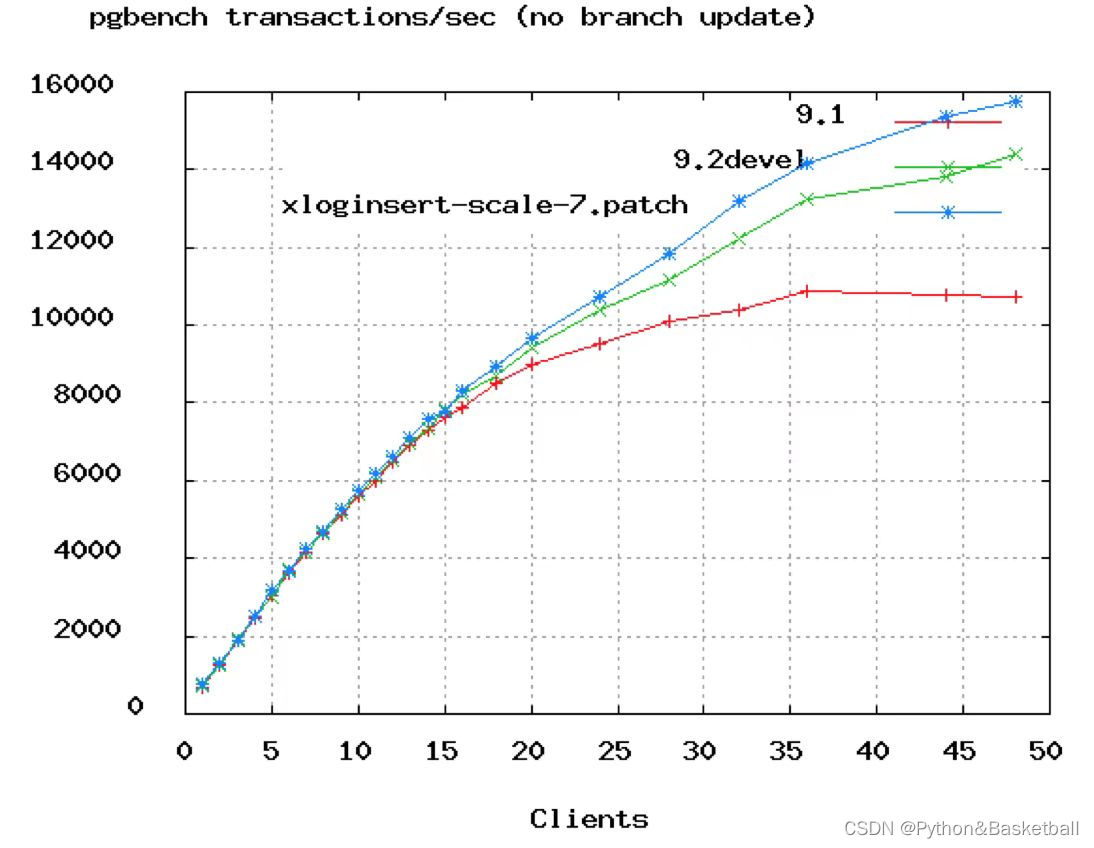
You can see in the above PostgreSQL benchmark that TPS rates start to flatten out at around 50 connections. And in Oracle's video above they showed dropping the connections from 2048 down to just 96. We would say that even 96 is probably too high, unless you're looking at a 16 or 32-core box.The Formula
The formula below is provided by the PostgreSQL project as a starting point, but we believe it will be largely applicable across databases. You should test your application, i.e. simulate expected load, and try different pool settings around this starting point:connections = ((core_count * 2) + effective_spindle_count)
A formula which has held up pretty well across a lot of benchmarks for years is
that for optimal throughput the number of active connections should be somewhere
near ((core_count * 2) + effective_spindle_count). Core count should not include
HT threads, even if hyperthreading is enabled. Effective spindle count is zero if
the active data set is fully cached, and approaches the actual number of spindles
as the cache hit rate falls. ... There hasn't been any analysis so far regarding
how well the formula works with SSDs.
Guess what that means? Your little 4-Core i7 server with one hard disk should be running a connection pool of: 9 = ((4 * 2) + 1). Call it 10 as a nice round number. Seem low? Give it a try, we'd wager that you could easily handle 3000 front-end users running simple queries at 6000 TPS on such a setup. If you run load tests, you will probably see TPS rates starting to fall, and front-end response times starting to climb, as you push the connection pool much past 10 (on that given hardware).Axiom: You want a small pool, saturated with threads waiting for connections.
If you have 10,000 front-end users, having a connection pool of 10,000 would be shear insanity. 1000 still horrible. Even 100 connections, overkill. You want a small pool of a few dozen connections at most, and you want the rest of the application threads blocked on the pool awaiting connections. If the pool is properly tuned it is set right at the limit of the number of queries the database is capable of processing simultaneously -- which is rarely much more than (CPU cores * 2) as noted above.We never cease to amaze at the in-house web applications we've encountered, with a few dozen front-end users performing periodic activity, and a connection pool of 100 connections. Don't over-provision your database."Pool-locking"
The prospect of "pool-locking" has been raised with respect to single actors that acquire many connections. This is largely an application-level issue. Yes, increasing the pool size can alleviate lockups in these scenarios, but we would urge you to examine first what can be done at the application level before enlarging the pool.The calculation of pool size in order to avoid deadlock is a fairly simple resource allocation formula:pool size = Tn x (Cm - 1) + 1Where Tn is the maximum number of threads, and Cm is the maximum number of simultaneous connections held by a single thread.For example, imagine three threads (Tn=3), each of which requires four connections to perform some task (Cm=4). The pool size required to ensure that deadlock is never possible is:pool size = 3 x (4 - 1) + 1 = 10Another example, you have a maximum of eight threads (Tn=8), each of which requires three connections to perform some task (Cm=3). The pool size required to ensure that deadlock is never possible is:pool size = 8 x (3 - 1) + 1 = 17👉 This is not necessarily the optimal pool size, but the minimum required to avoid deadlock.👉 In some environments, using a JTA (Java Transaction Manager) can dramatically reduce the number of connections required by returning the same Connection from getConnection() to a thread that is already holding a Connection in the current transaction.
这个就不翻译了,大家应该能看懂,其实不需要很大的链接数
4、HikariCP配置
HikariCP配置数据库信息
classpath:hibernate.properties
配套软件版本:
Obs.: the versions are
log4j: 1.2.16
springframework: 3.1.4.RELEASE
HikariCP: 1.4.0
5、数据库配置文件
Properties file (hibernate.properties):
hibernate.dataSourceClassName=oracle.jdbc.pool.OracleDataSource
hibernate.hikari.maximumPoolSize=10
hibernate.hikari.idleTimeout=30000
dataSource.url=jdbc:oracle:thin:@localhost:1521:xe
dataSource.username=admin
dataSource.password=
参照:https://stackoverflow.com/questions/23172643/how-to-set-up-datasource-with-spring-for-hikaricp
相关内容
热门资讯
苗族的传统节日 贵州苗族节日有...
【岜沙苗族芦笙节】岜沙,苗语叫“分送”,距从江县城7.5公里,是世界上最崇拜树木并以树为神的枪手部落...
北京的名胜古迹 北京最著名的景...
北京从元代开始,逐渐走上帝国首都的道路,先是成为大辽朝五大首都之一的南京城,随着金灭辽,金代从海陵王...
应用未安装解决办法 平板应用未...
---IT小技术,每天Get一个小技能!一、前言描述苹果IPad2居然不能安装怎么办?与此IPad不...
脚上的穴位图 脚面经络图对应的...
人体穴位作用图解大全更清晰直观的标注了各个人体穴位的作用,包括头部穴位图、胸部穴位图、背部穴位图、胳...
长白山自助游攻略 吉林长白山游...
昨天介绍了西坡的景点详细请看链接:一个人的旅行,据说能看到长白山天池全凭运气,您的运气如何?今日介绍...
猫咪吃了塑料袋怎么办 猫咪误食...
你知道吗?塑料袋放久了会长猫哦!要说猫咪对塑料袋的喜爱程度完完全全可以媲美纸箱家里只要一有塑料袋的响...
demo什么意思 demo版本...
618快到了,各位的小金库大概也在准备开闸放水了吧。没有小金库的,也该向老婆撒娇卖萌服个软了,一切只...
世界上最漂亮的人 世界上最漂亮...
此前在某网上,选出了全球265万颜值姣好的女性。从这些数量庞大的女性群体中,人们投票选出了心目中最美...
埃菲尔铁塔在哪 中国仿建埃菲尔...
2019年4月26日,广西南宁市,街头惊现一座巨型山寨版埃菲尔铁塔,高约20米,白色塔身,造型逼真,...
苗族的传统节日 贵州苗族节日有...
【岜沙苗族芦笙节】岜沙,苗语叫“分送”,距从江县城7.5公里,是世界上最崇拜树木并以树为神的枪手部落...
北京的名胜古迹 北京最著名的景...
北京从元代开始,逐渐走上帝国首都的道路,先是成为大辽朝五大首都之一的南京城,随着金灭辽,金代从海陵王...
应用未安装解决办法 平板应用未...
---IT小技术,每天Get一个小技能!一、前言描述苹果IPad2居然不能安装怎么办?与此IPad不...
脚上的穴位图 脚面经络图对应的...
人体穴位作用图解大全更清晰直观的标注了各个人体穴位的作用,包括头部穴位图、胸部穴位图、背部穴位图、胳...
长白山自助游攻略 吉林长白山游...
昨天介绍了西坡的景点详细请看链接:一个人的旅行,据说能看到长白山天池全凭运气,您的运气如何?今日介绍...